 Kerbio
From 30 November 2026 you do not need a fresh EICR for each change of tenant: an inspection within the last five years whose next-inspection date has not passed satisfies the before-tenancy duty. From the same date any new inspection is against BS 7671:2018+A4:2026, and a report that finds problems leads to remedial work within 28 days without the separate "further investigative work" round. Inspections completed before 30 November stay under the old wording. Everything else in the 2020 Regulations, including the five-year cycle, the 28-day supply rule and the £40,000 maximum penalty, is as it was.
Before and after
| Rule | Until 29 November 2026 | From 30 November 2026 | Provision |
|---|---|---|---|
| Standard referenced | BS 7671:2018 | BS 7671:2018+A4:2026 | Regulation 2 of the 2020 Regulations, amended by regulation 3 |
| "Inspected and tested before the tenancy" | The Regulations said only that every installation must be inspected and tested by a qualified person before the tenancy commences; whether an existing report counted was not spelt out | Satisfied by an inspection within the last five years with a report that is still current: either under the Regulations (next-inspection date not passed) or by a qualified person outside them (any next-inspection date not passed) | New regulation 3(1A) and (1B), inserted by regulation 4(b) |
| After a report that finds a breach | "Further investigative or remedial work" within 28 days (or the shorter period the report states), written confirmation to tenants and the council within 28 days of completion, repeated where investigation found more | Remedial work within 28 days (or the shorter period stated), written confirmation within 28 days of completion; the investigative step and the repeat rule in regulation 3(6) are removed. Saving: inspections completed before 30 November keep the old steps | Regulation 3(4), (5), (6), (8) and 10(1)(b), amended by regulations 4(e) to (h), 8(a); saving in regulation 9 |
| Electrical equipment checks (social landlords only) | Each item of relevant equipment checked by a qualified person before the tenancy commences | Satisfied by a check within the last five years with a record, or ISIT record, that is still current, item by item | New regulation 3B(1A) and (1B), inserted by regulation 5; registered providers only |
Read from SI 2026/1196 and the consolidated 2020 Regulations on legislation.gov.uk on 17 November 2026. The instrument also replaces "sub-paragraph" with "paragraph" in several places and is issued free as a correction of defects in SI 2020/312 and SI 2025/1043.
What to do
Find the next-inspection date on your current EICR. If it has not passed, that report satisfies the before-tenancy duty for any new tenancy from 30 November 2026, whether or not the inspection was done under the Regulations (regulation 3(1A)).
If the date has passed, or there is no report, book an inspection and test; from 30 November the electrician tests to BS 7671:2018+A4:2026 (regulation 3).
Keep giving each existing tenant a copy within 28 days of the inspection, give a new tenant the latest report before they move in, and send the council a copy within 7 days of a written request (regulation 3(3)); keep the report until the next one (regulation 3(3)(ca)).
Where a report requires work, have a qualified person do it within 28 days or the shorter time the report states, and send the written confirmation to tenants and the council within 28 days of completion (regulation 3(4) and (5)). If the inspection was completed before 30 November, the old further investigative work steps still apply to it (regulation 9).
Social landlords: the same five-year carry-over applies to the electrical equipment checks, item by item, with a current ISIT record (regulation 3B(1A)).
What does not change
Inspection and test at intervals of no more than five years, or by the earlier date the last report sets (regulation 3(2)).
unchangedReport to existing tenants within 28 days; remedial work within 28 days; confirmation within 28 days of completion (regulation 3(3) to (5)).
unchangedUp to £40,000 per breach from the local housing authority, which can also arrange remedial action and recover the cost (regulations 11 and 10).
unchangedThe instrument
The Electrical Safety Standards in the Private Rented Sector and Social Rented Sector (England) (Amendment) Regulations 2026, SI 2026/1196. Made 13 November 2026; a draft was approved by resolution of each House (section 214(2) of the Housing and Planning Act 2016); published on legislation.gov.uk 17 November 2026; in force 30 November 2026 (regulation 1(2)). Extends to England and Wales; the 2020 Regulations apply to England. Regulation 9: "The amendments made by regulations 4(e), (f) and (g) and 8(a) are of no effect in relation to an inspection and test that was completed under regulation 3 of the Electrical Safety Standards in the Private Rented Sector and Social Rented Sector (England) Regulations 2020 before 30th November 2026."
The explanatory memorandum for SI 2026/1196 was not served as a document on legislation.gov.uk when this page was written on 17 November 2026 (the memorandum page returned only a contents shell); the explanatory note at the end of the instrument is quoted instead. MHCLG's guidance page was last updated on 1 November 2025 and did not mention BS 7671:2018+A4:2026 or the 30 November 2026 changes when checked on 17 November 2026; the older landlord guidance page from 2020 named in the radar brief no longer resolves. This page will be updated when the guidance is.
Questions
Do I need a new EICR every time a tenant changes?
Not if the current one is in date. New regulation 3(1A) of the 2020 Regulations, inserted by SI 2026/1196: an inspection and test "takes place before a specified tenancy commences" if, no more than five years before, an inspection under the Regulations produced a report that is still current, or a qualified person inspected and tested outside the Regulations and gave you a report that is still current. "Still current" means the next-inspection date in the report has not passed (regulation 3(1B)). That is the rule from 30 November 2026; the duty itself in regulation 3(1)(c) is unchanged.
What standard must the electrician test to?
From 30 November 2026 the "electrical safety standards" in regulation 2 of the 2020 Regulations are BS 7671:2018+A4:2026, the 18th Edition as amended by Amendment 4 (In regulation 2, in the definition of "electrical safety standards", for "BS 7671: 2018" substitute "BS 7671:2018+A4:2026".). Before that date the Regulations refer to BS 7671:2018. A report from an inspection completed before 30 November is not invalidated; the saving in regulation 9 keeps the old wording for inspections completed before that date.
What happened to further investigative work?
The 2020 Regulations required a landlord to carry out "further investigative or remedial work" within 28 days where the report called for it, with written confirmation afterwards and a repeat where the investigation found more (regulation 3(4) to (6)). SI 2026/1196 removes "further investigative or" from regulations 3(4), (5) and (8) and omits regulation 3(6) (regulation 4(e) to (g)); regulation 10(1)(b), on urgent remedial action by the council, loses "or investigative". The explanatory note says this reflects changes to the IET Wiring Regulations. For inspections completed before 30 November 2026 the old steps still apply (regulation 9).
Does the 28-day rule change?
No. Regulation 3(3)(b) still requires a copy of the report to each existing tenant within 28 days of the inspection, and regulation 3(4) still requires remedial work within 28 days, or the shorter period the report states, from the date of the inspection, with written confirmation to tenants and the council within 28 days of completion (regulation 3(5)). The report also goes to a new tenant before they move in and to a prospective tenant within 28 days of a written request (regulation 3(3)(e)), and to the council within 7 days of a request (regulation 3(3)(c)).
Does this apply to HMOs?
Yes. The 2020 Regulations apply to every specified tenancy of residential premises in England, and HMOs have been inside them since 1 June 2020; nothing in SI 2026/1196 changes the scope. Social landlords are inside the Regulations since the 2025 extension, and regulation 5 of the amending instrument gives them the same five-year carry-over for the electrical equipment checks they must make.
Is the penalty changing?
No. The amending instrument does not touch regulation 11; the local housing authority can still impose a financial penalty of up to £40,000 for a breach, and arrange remedial action and recover the cost.
Is this advice?
No. It states what SI 2026/1196 and the 2020 Regulations say, with the regulation numbers, and what the explanatory note says. The explanatory memorandum for SI 2026/1196 was not served as a document on legislation.gov.uk when this page was written on 17 November 2026 (the memorandum page returned only a contents shell); the explanatory note at the end of the instrument is quoted instead. Check with your electrician and the council's guidance for your own case.
About this guide
Written by Kerbio, a small independent UK tool for property investors, on 17 November 2026 from the amending instrument and the consolidated 2020 Regulations on legislation.gov.uk. Regulation numbers are given so you can check each line. An explainer, not legal advice.
Kerbio is a Chrome extension that puts licensing, Article 4, the council's HMO register and sold prices on the listing you are reading.
See the extension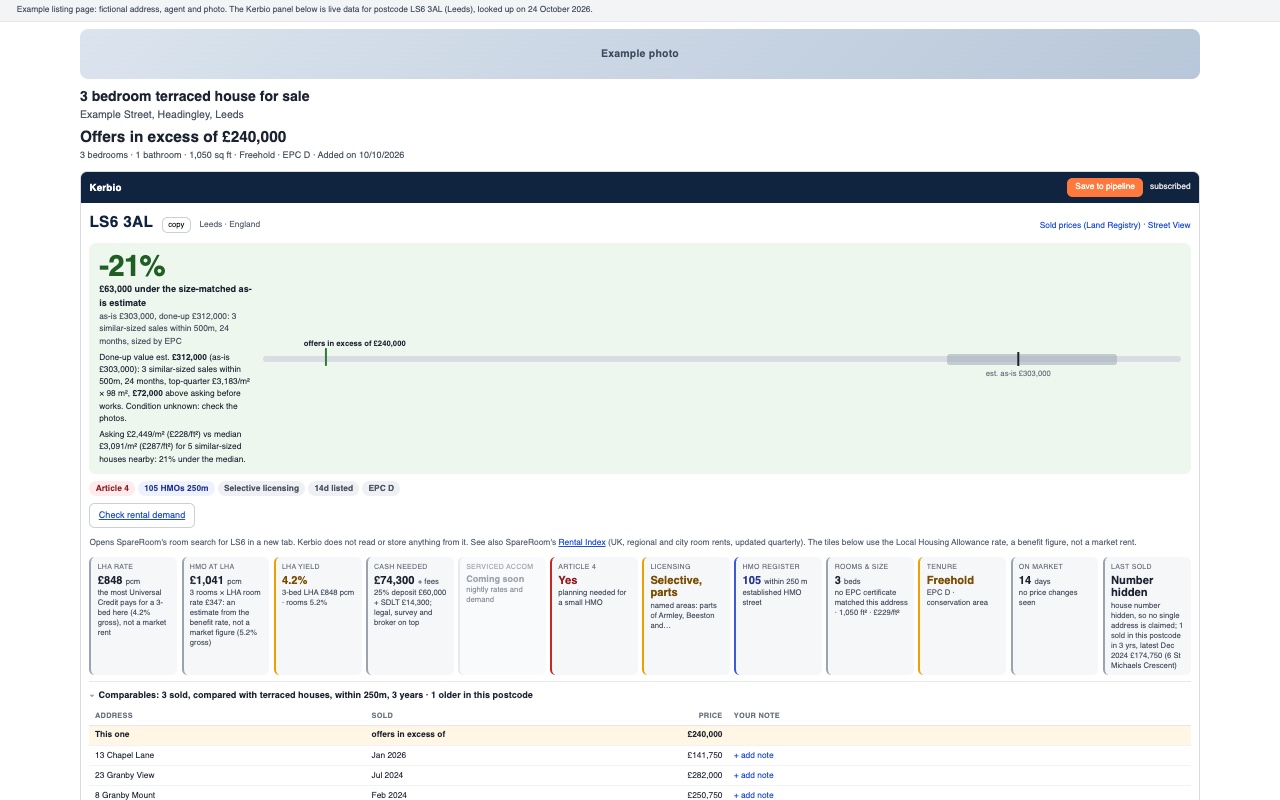
Sources
- The Electrical Safety Standards in the Private Rented Sector and Social Rented Sector (England) (Amendment) Regulations 2026, SI 2026/1196, made 13 November 2026 (legislation.gov.uk); explanatory memorandum page
- The Electrical Safety Standards in the Private Rented Sector and Social Rented Sector (England) Regulations 2020, SI 2020/312, regulation 3 as amended to 1 May 2026 (legislation.gov.uk)
- Electrical safety standards in the private and social rented sectors: guidance (MHCLG guidance, last updated 1 November 2025)
- Kerbio's landlord compliance checklist, EICR item updated 17 November 2026
Checked 17 November 2026. Quotations in SOURCES.txt. England only. General information, not legal advice.