 Kerbio
If your rent is close to the LHA and empty months or agent fees are eating into it, a council scheme is worth one email. If your rent is well above the LHA, it usually isn’t: you’d be swapping a few empty weeks for a permanent rent cut.
What does your council pay?
Taken from each council’s own website.Four ways the council can pay you
The council becomes your tenant for 1 to 9 years and pays rent every month, empty or not.
14 councilsA shorter agreement with the same promise: a fixed rent, whether anyone lives there or not.
5 councilsThe council finds the tenant and runs the tenancy, usually for 6% to 12% of the rent.
10 councilsYou let to a household the council nominates. It pays you cash, the deposit and rent in advance.
113 councils, plus 66 offering severalPublished upfront payments
One-off payments to landlords who house a household the council nominates. This is the highest figure each council publishes; most pay less, and many pay by bedroom size.
How the numbers compare: one two-bed, four ways
Net income in year one. Round, made-up figures to show the arithmetic: swap in your own rent, the LHA for your area and your agent's fee.
The council pays £150 a month less, but there’s no empty month and no agent. That’s enough to beat an agent-managed let (£9,000 against £8,712). It loses to a self-managed let, by £900 a year, as long as you never have more than a month empty.
The incentive let comes top in year one thanks to the £2,000 payment. From year two it’s a normal tenancy at below-market rent, with normal risks.
How to get the council as your tenant
Type your council into the box above.
Compare your rent with the LHA. That's roughly what councils pay.
Gas safety, EICR, EPC of E or better, alarms.
Mortgage lender, insurer, and freeholder if leasehold.
The council inspects, lists any fixes, then offers terms.
Contact your council: everything you need
The email below asks the five things that decide whether a scheme is worth it to you: the rent, the length, who repairs what, when you’re paid, and the paperwork. Fill in your details and send it from your own email.
The private sector housing team, sometimes called the landlord, lettings or private sector leasing team. Use the council's own page, linked from its result in the finder above.
- Address, type and bedrooms
- When it is available, and whether it is empty
- Gas safety certificate, EICR and EPC
- Your rent expectation
- Mortgage lender and insurer details
- Which scheme fits, and what rent or payment
- Lease length and any break clause
- Who repairs what, and the hand-back condition
- When rent is paid, and what happens if the scheme closes
Your email, ready to send
It updates as you type. Nothing you type leaves this page.
The trade, in one place
- Rent every month, empty or not (on a lease)
- No letting or management fees
- The council deals with the occupants
- The house handed back in the agreed condition
- Cash upfront on incentive schemes
- Rent usually at or below LHA, often under market
- Selling it empty: you can sell during the lease, but the buyer takes over the council lease
- Control over who lives there
- Certainty: schemes open and close with council budgets
Questions landlords ask
Can I let my property to the council?
Usually, yes. 208 of the 296 English councils we checked run a scheme for private landlords. Type your council into the box at the top of this page.
Do councils pay market rent?
Rarely in full. Most pay at or near the Local Housing Allowance (LHA) for the area and bedroom size. Wakefield publishes 10% below market rent; Oxford publishes monthly maximums, £900 for a one-bed.
Is the rent paid if the house is empty?
On a council lease or guaranteed rent scheme, yes (Lewisham, North Devon and Norwich all say so). On an incentive scheme, no: you are the tenant's landlord on a normal tenancy.
How long is a council lease?
Usually 3 to 5 years. The range is 1 year (Oxford) to 9 years (Lewisham), and some have break clauses, like the Isle of Wight's 3 months' notice after year one.
Do I need my mortgage lender's consent?
Check first. Many buy-to-let mortgages restrict lets to councils, companies or tenants on benefits, and your insurer needs to know. Some councils ask for both consents in writing.
Can I sell my house during a council lease?
Usually yes, but the lease normally goes with the house, so the buyer takes over the council as tenant until the lease ends. That suits investors who want the income, not buyers who want to move in. You can only offer an empty house earlier if the lease has a break clause you can use or the council agrees to end it. Check the lease before you sign.
Does the Renters' Rights Act apply to a council lease?
The Act changed tenancies between landlords and individual tenants, ending Section 21 from 1 May 2026. Under a council lease the council is your tenant and the lease sets the term and hand-back date. Ask the council, or a solicitor, how its lease works under the new rules before you sign.
About this guide
Written by Kerbio, a small independent UK tool for property investors. No council, letting agent or guaranteed rent company pays us, and nothing here is sponsored or ranked for money. We built the council list by reading each council's own website.
We also make a Chrome extension that shows the LHA, sold prices, licensing and Article 4 on property listings, if you are buying a house to let.
See the extension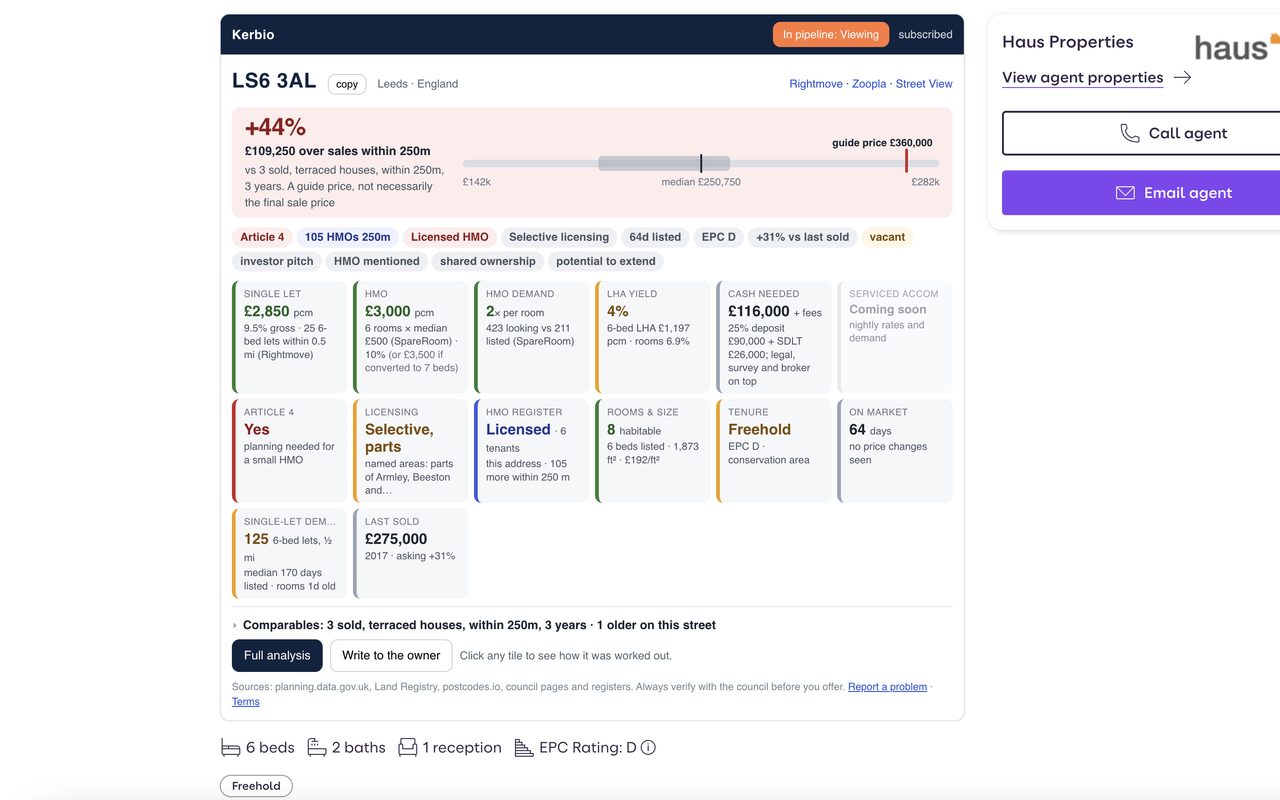
Figures from the councils' own pages, collected in our council leasing directory and last checked 2026-09-29. Schemes change with council budgets, so confirm with the council. The four-way comparison is illustrative arithmetic, not a forecast. General information, not financial or legal advice.