 Kerbio
Six things most buyers don't know about bridging
A market value bridge ignores your purchase price. Asking £240k, agreed £200k: 75% of £240k is £180k, so you find £20k, not £50k. Deposits of 15%, 10%, even 5% are possible.
Mortgages are lent on your income. Bridges are lent on the property and the plan to repay. Missed payments or CCJs don't automatically rule you out; being bankrupt now does.
A done-up value bridge looks at what the house will be worth once finished, so there's rarely a deposit. The seller has to accept a delayed completion while the works are done.
Cross-collateral uses equity in another property as security instead of cash: up to about 75% on a mortgage-free home, 65% on one with a mortgage. Both are at risk until it's repaid.
A refurb bridge can lend 100% of the works, paid in stages after an inspector signs each one off. You pay the first stage; the lender reimburses you.
Unlike a mortgage, most bridges have no early repayment penalty. With retained interest, repay in month 8 of 12 and the unused months are usually refunded.
None of this removes the need for cash altogether: stamp duty, the arrangement fee, legal and valuation costs still have to be paid. Try your own numbers in the calculator below.
How a bridge works, in three steps
A short loan secured on the property, usually up to 12 months, arranged in weeks, not months.
Buy, refurbish, fix whatever stops a mortgage lender lending. Interest is usually deducted upfront, so nothing is paid monthly.
Repay the loan and interest from a buy-to-let mortgage or a sale. No exit, no loan.
The five ways to structure a bridge
The difference between them is what the lender lends against. That decides how much of your own cash goes in on day one.
- Lends on
- The price or value, whichever is lower.
- Your cash
- About 25% of the price, plus fees and stamp duty.
- Fits
- The default when there's no discount and no big refurb.
- Lends on
- The asking price or value, not what you pay.
- Your cash
- Falls as your discount grows; can be 5% to 15%.
- Fits
- Long time on market, price cuts, a motivated seller.
- Lends on
- The price or value, plus 100% of the works.
- Your cash
- About 25% of the price; the works are funded.
- Fits
- Homes that need work before they can be mortgaged.
- Lends on
- The value after the works.
- Your cash
- Often little or no deposit; fees still due.
- Fits
- Big uplift deals where the seller accepts delayed completion.
- Lends on
- This property plus equity in one you own.
- Your cash
- Fees and costs only; equity replaces the deposit.
- Fits
- Adds to any of the four above, if you have equity.
Cash needed on day one: five structures, side by side
Change any number. Figures are indicative: lenders' terms, valuations and fees vary, so check every figure with a broker.Just want the cost of a loan, what you receive after retained interest, or monthly payments? Use the bridging loan calculator.
Work out your maximum offer
The Kerbio Deal Analyser is an Excel spreadsheet that finds the most you can pay to hit your target profit, with cash needed on day one under each bridge type and BRRR money left in.
See the Deal Analyser, £24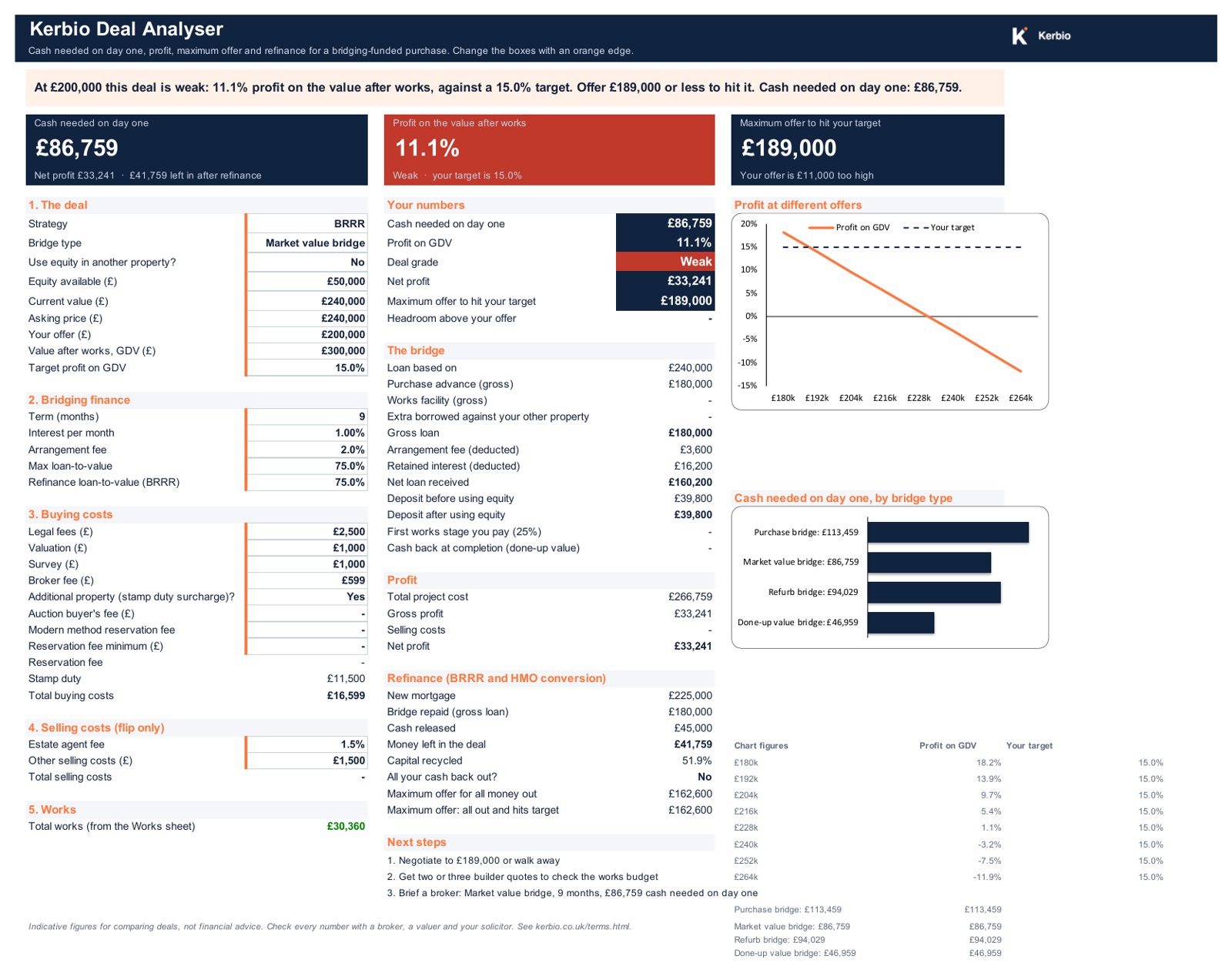
What it costs: the real price of a bridge
On the worked example above (£200,000 price, 75% loan, 1% a month for 9 months, 2% arrangement fee), the purchase bridge's loan of £150,000 costs about £16,500 in fees and interest, before valuation and legal fees. That is the number to weigh against the discount or the uplift the bridge lets you capture.
- A discount or an uplift bigger than the finance cost
- An exit that works on a cautious valuation
- Works priced properly, with a contingency
- Repaying early: most bridges have no early repayment charge
- The refinance valuation comes in low, and you fund the gap
- Works overrun, and interest keeps rolling up
- Mortgage rates move before you refinance
- Missing the term: a new arrangement fee, or penalty interest of 3% to 5% a month
- A 90 or 180-day valuation basis lowers the loan
Talking to a broker: have this ready
- Address, price agreed and asking price
- Sold comparables for the value today
- Comparables for the value after works
- A schedule of works with costs
- A contingency, often 10% to 15%
- Timeline and who is doing it
- Your experience and other properties
- Proof of funds for deposit and fees
- The exit plan, with an agreement in principle
Questions investors ask
How does a bridging loan work?
A lender secures a short loan, usually up to 12 months, against a property so you can buy or refurbish it quickly. Interest is usually retained, which means the lender deducts it from the loan at the start, so there are no monthly payments. The loan is repaid at the end from a sale or a refinance. That repayment plan is called the exit, and lenders will ask for it before anything else.
How much does a bridging loan cost?
Interest is quoted monthly. The average in the first quarter of 2026 was 0.82% a month, and typical deals run from about 0.83% to 1.25% a month depending on the loan-to-value. On top of that expect an arrangement fee (often around 2%), a physical valuation, and two sets of legal fees: bridging lenders use their own solicitor, and you pay for both. Exit fees are now less common.
Can I get a bridging loan with bad credit?
Often, yes. Bridging lenders lend on the property and your plan to repay, not on your income, so missed payments, defaults or CCJs don't automatically rule you out. Someone who is currently bankrupt can't borrow. If poor credit would stop you refinancing onto a mortgage later, plan to sell instead.
What is the smallest bridging loan?
Under about £25,000 the valuation, legal and arrangement costs usually make it poor value. From £25,000 to £100,000 fewer lenders take part. Most lenders are active between £100,000 and £2 million.
Can a bridging loan cover stamp duty?
Usually not directly. Stamp duty, legal and valuation fees are normally paid from your own money on completion. A done-up value bridge or extra security on another property (cross-collateral) can lend enough that less of your own cash goes into the purchase, which frees money for those costs.
Can bridging finance cover the deposit?
In effect, yes, in three of the five structures. A market value bridge lends on the asking price or value, so a negotiated discount replaces part of the deposit. A done-up value bridge lends on the value after works. Cross-collateral uses equity in a property you already own instead of cash.
Is bridging finance regulated?
Only if you or a close family member will live in at least 40% of the property; then it is regulated by the Financial Conduct Authority. Bridges for buy-to-let, investment or commercial property are usually unregulated, so there are fewer consumer protections. Check which applies before you sign.
How long does a bridging loan take?
The average in early 2026 was 53 days from application to completion. Simple deals with a clear exit and a quick valuation can be faster; refurb and done-up value deals take longer because the works schedule and the valuation both need sign-off.
Can a bridging loan be extended?
Sometimes, but not by right. An extension usually means new fees, a higher rate or default interest. Plan the exit so it works well inside the term, not at the very end of it.
About this guide
Written by Kerbio, a small independent UK tool for property investors. We are not a lender or a broker, nobody pays us to mention them, and this is general information, not financial advice. The five structures follow how UK bridging lenders commonly lend; market figures are from the Bridging Trends survey for the first quarter of 2026.
We also make a Chrome extension that shows sold prices, time on market, price cuts and Article 4 on property listings, the numbers behind a market value or done-up value bridge.
See the extension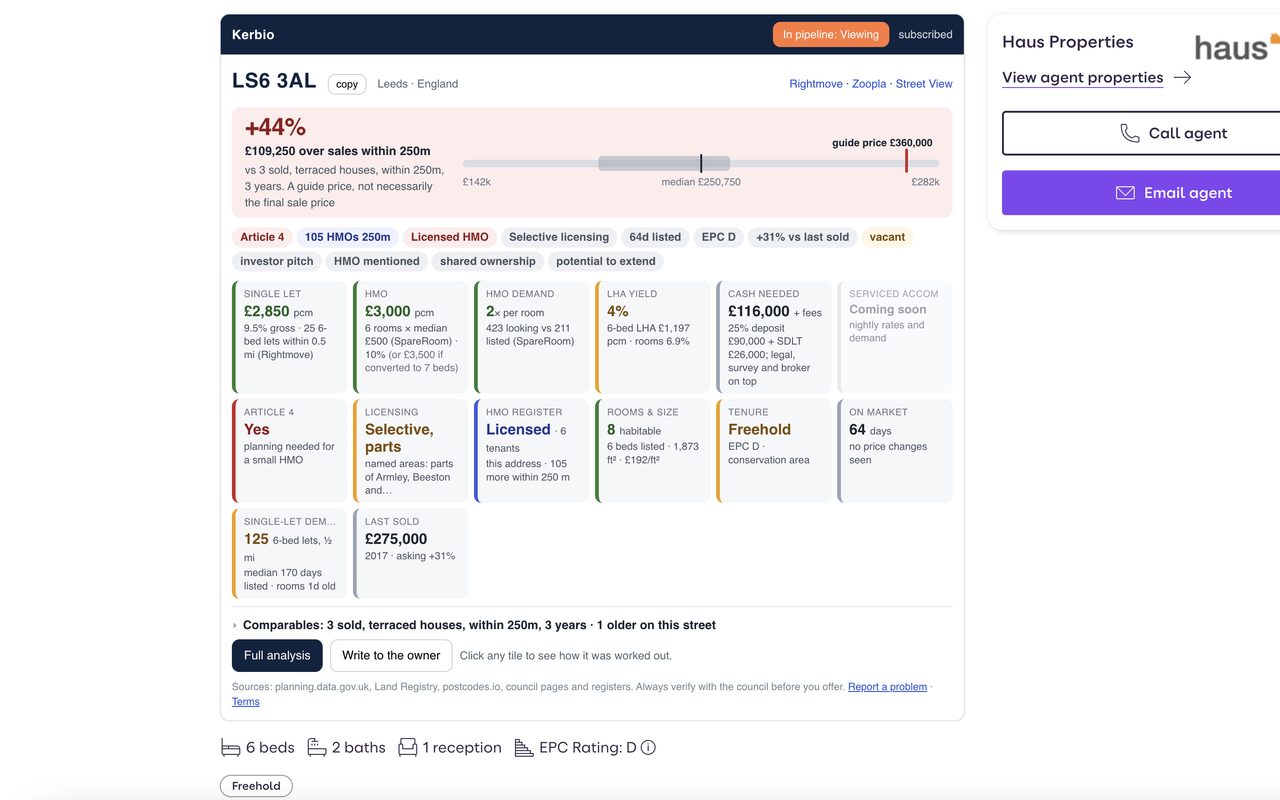
Representative figures. Every bridging lender's rate, fees and loan-to-value differ, so put in the terms from your own quote.
Market figures: Bridging Trends, Q1 2026 (average monthly rate 0.82%, loan-to-value 52%, term 12 months, 53 days to complete). Stamp duty uses the England and Northern Ireland residential rates with the 5% surcharge for additional properties; Wales and Scotland differ. The calculator is illustrative arithmetic: it follows a retained-interest model: the arrangement fee and interest for the whole term are deducted from the loan on day one, other costs are paid from your cash, and on a refurb bridge you pay the first 25% of the works. General information, not financial advice; speak to a regulated broker.