 Kerbio
Nothing changes for private landlords yet. The consultation published on 9 October 2026 uses the social-sector rules as its starting point and asks, step by step, whether private landlords should get the same deadlines, shorter ones or longer ones, which hazards should come first, and whether it should start in 2027, 2028 or 2029. Regulations follow after 18 December 2026. If you let in England, this is the moment to say what is workable, and to start keeping the kind of dated record the rules will expect.
What Awaab's Law already requires of social landlords
The baseline MHCLG puts forward. In force for social tenancies in England since 27 October 2025; the consultation describes it in section 3 and the questions in section 4 offer it as the "in line with social housing" option at each step.
- Day 0ReportThe landlord becomes aware of a potential hazardFrom a tenant, a contractor, a medical referral: any route
- Step 110 wdInvestigate, by someone competent to judge the riskPhotos and video can do; a physical inspection if the tenant asks
- Step 23 wdWritten summary to the tenant after the investigation concludesNot needed if all the work is finished first
- Step 35 wdMake the home safe, temporary measures allowedFollow-up works start within 5 wd, or steps taken, and begin within 12 weeks
- Emergency24 hInvestigate and make safe, as soon as practicableAlternative accommodation if the home cannot be made safe in time
"wd" is working days: not Saturdays, Sundays, Christmas Day, Good Friday or bank holidays in England. The day the landlord becomes aware is day zero; after an investigation, day one is the day after it concludes. Social landlords have a defence if they took all reasonable steps but could not comply for reasons genuinely beyond their control.
What the consultation asks
For each step, the options as the document lists them. The social-sector figure is marked in bold and labelled "in line with social housing requirements" in the questions; "other" and "don't know" are also offered each time.
| Step | Social now | Options for private tenancies | Question |
|---|---|---|---|
| Investigate a potential significant hazard | 10 wd | 5 wd / 10 wd / 15 wd | Q11 |
| Written summary to the tenant | 3 wd | 1 wd / 3 wd / 5 wd Q14 asks whether a summary should be required at all | Q15 |
| Make a significant hazard safe | 5 wd | 3 wd / 5 wd / 10 wd | Q18 |
| Start follow-up works to stop it recurring | 5 wd | 3 wd / 5 wd / 10 wd Q20: allow steps towards starting, with a 12-week backstop, as in social housing? | Q19 |
| Investigate and make safe an emergency | 24 hours | 12 hours / 24 hours / 48 hours Q22: should emergencies have their own timescale at all? | Q23 |
| Phasing | 3 phases | Phase it as social housing was, or bring everything in at once; if phased, damp and mould plus emergencies first? | Q29, 29A, 29B |
| Start | Oct 2025 | 2027 / 2028 / 2029 / other. The document calls 2027 the earliest feasible date. | Q30 |
| Ombudsman first? | n/a | Should the PRS Landlord Ombudsman (expected 2028) be running before Awaab's Law starts? | Q31 |
Worked example: a hazard reported on a Friday, on the social-sector timescales
Illustration only: the social-sector deadlines applied to a private let, which is one of the options, not a decision. Working days skip weekends and England's bank holidays.
| Event | Significant hazard (damp reported Fri, 8 Jan 2027) | Emergency (reported Fri, 8 Jan 2027, 5.30pm) |
|---|---|---|
| Investigation deadline | Fri, 22 Jan 2027 (10 wd) | Sat, 9 Jan 2027, 5.30pm (24 hours), and make safe by then too |
| Written summary, if the investigation concludes on its deadline | Wed, 27 Jan 2027 | Wed, 13 Jan 2027 |
| Make safe | Fri, 29 Jan 2027 | within the 24 hours |
| Follow-up works: start, or steps taken | Fri, 29 Jan 2027 | Fri, 15 Jan 2027 |
| Follow-up works: latest physical start | Fri, 16 Apr 2027 (12 weeks) | Sat, 3 Apr 2027 |
Investigate sooner and every later date moves earlier with it: the summary, make-safe and follow-up clocks all run from the day the investigation concludes, not from its deadline. Put your own dates and the other options into the calculator.
Who it would apply to
Private rented sector tenancies, through an implied term the Act puts into the agreement. Landlords cannot contract out.
ProposedNo separate HMO rules in the document: a tenant in an HMO is a private tenant. Licence conditions and HHSRS enforcement by the council carry on as now.
Our readingThe document proposes covering temporary accommodation, supported housing and care leaver accommodation occupied under licence, with their own questions in section 5.
ProposedOvercrowding is outside Awaab's Law. Scotland, Wales and Northern Ireland have their own housing law; this is England.
ExcludedHow it would be enforced
- Breach of the implied term: the tenant can go to court for an order to do the work, compensation and costs.
- The Pre-Action Protocol for Housing Conditions Claims comes first and pushes both sides to settle before court.
- Later, a complaint to the PRS Landlord Ombudsman, expected from 2028, which can order action and award compensation.
- Councils keep their HHSRS powers, improvement notices and the Act's financial penalties, but get no direct role in policing Awaab's Law deadlines.
- Your existing repairing duties and fitness for human habitation do not change; Awaab's Law adds timescales to them.
- A defence for landlords who took all reasonable steps is part of the social rules; the consultation asks how it should work for private lets.
What to do now, whatever the final numbers
Practical preparation, not legal advice. None of this is required yet; all of it is cheap, and the records are what a tenant, a court or an ombudsman would ask for.
Respond before 18 December 2026
Online at consult.communities.gov.uk, or by email to awaabslawconsultation@communities.gov.uk, by 11:59pm on 18 December 2026. There are 64 questions across three parts; you can skip any you have no view on. The ones where a small landlord's experience counts most:
- Q11, 15, 18 to 20, 23: the number of working days or hours at each step. Say what you can actually do, and why.
- Q12: who should be allowed to investigate.
- The "challenges" questions: how hard it is to get tradespeople, specialist investigators and access to the property in your area.
- Q29 to 31: phasing, the start year and whether the ombudsman should exist first.
Questions
Is Awaab's Law law for private landlords yet?
No. The Renters' Rights Act 2025 gives the government the power to apply it to private tenancies and to licences, and the consultation published on 9 October 2026 asks how. Regulations come after the consultation closes on 18 December 2026. The document says the earliest feasible start is 2027, and asks whether it should be 2027, 2028, 2029 or later.
What are the proposed deadlines?
The consultation does not fix numbers. For each step it offers options and marks one "in line with social housing": investigate within 5, 10, 15 working days (social: 10); written summary within 1, 3, 5 working days (social: 3); make safe within 3, 5, 10 working days (social: 5); start follow-up works within 3, 5, 10 working days with a 12-week backstop; and investigate and make safe emergencies within 12, 24, 48 hours (social: 24). Our calculator lets you try each.
Which hazards would it cover?
All 29 Housing Health and Safety Rating System hazards except overcrowding, where a hazard is significant or an emergency. In the social sector that is being phased in: damp and mould plus all emergencies from 27 October 2025; from 30 November 2026 excess cold, excess heat, domestic hygiene, falls, electrical hazards, explosions and structural collapse (SI 2026/1195, made 13 November 2026 after both Houses approved it, which also defines a significant hazard as one a reasonable landlord would make safe within 15 working days and an emergency as within 24 hours; fire hazards from Fire Safety Order parts of a block are excluded); the rest in 2027. The consultation asks whether private tenancies should be phased the same way, and which hazards should come first.
Does it apply to HMOs and to licences?
The consultation treats a tenancy in an HMO like any other private tenancy; it does not set separate HMO rules (our reading of the document, which mentions HMOs only in the hazard definitions). Separately, it proposes using the Act's power over licences to cover temporary accommodation, supported housing and care leaver accommodation occupied under licence. A licence to occupy a room in an owner's home is not in that list.
Who enforces it?
Under the Act an implied term goes into every private tenancy requiring the landlord to comply. If they do not, the tenant can go to court, which can order the repairs, compensation and costs. Complaints could also go to the Private Rented Sector Landlord Ombudsman once it exists, which the consultation expects in 2028. Councils keep their existing enforcement powers but would have no direct role in policing the deadlines.
What if the tenant will not let me in?
The consultation asks landlords how much of a challenge access is, and points to the social-sector defence: a landlord who can show they took all reasonable steps but could not comply for reasons genuinely beyond their control. How that defence would read for private tenancies is one of the open questions. Keeping dated records of every attempt to arrange access is the practical answer whatever the final rules say.
What would it cost me?
MHCLG's impact assessment assumes the private rules match the social ones and puts the extra cost at about £8.17 (range £5.64 to £10.69) per property per year, mostly the time to send written summaries, plus a one-off £37.54 per landlord to read the rules. It does not count the repairs themselves, because landlords already have to do them; the cost is doing them faster. It assumes phases in 2028, 2029 and 2030, which are assumptions for the analysis, not decisions.
How do I respond?
Online at the Citizen Space link on this page, or by email to awaabslawconsultation@communities.gov.uk, before 11:59pm on 18 December 2026. You can answer only the questions that matter to you. For a small landlord the questions on timescales (11, 15, 18 to 20, 23), phasing and start date (29 to 31) and the challenges you face (the access and tradespeople questions) are the ones where your experience counts most.
About this guide
Written by Kerbio, a small independent UK tool for property investors, on 2 November 2026 from the consultation document, MHCLG's impact assessment and the social-sector regulations and guidance. Nobody paid for it. Every figure is listed with its source below and in SOURCES.txt; the worked example and the calculator run the same code. Our landlord compliance checklist tracks the start date once there is one.
Kerbio is a Chrome extension that puts sold prices, Article 4, licensing, the council's HMO register and LHA rates on the property listing you are reading.
See the extension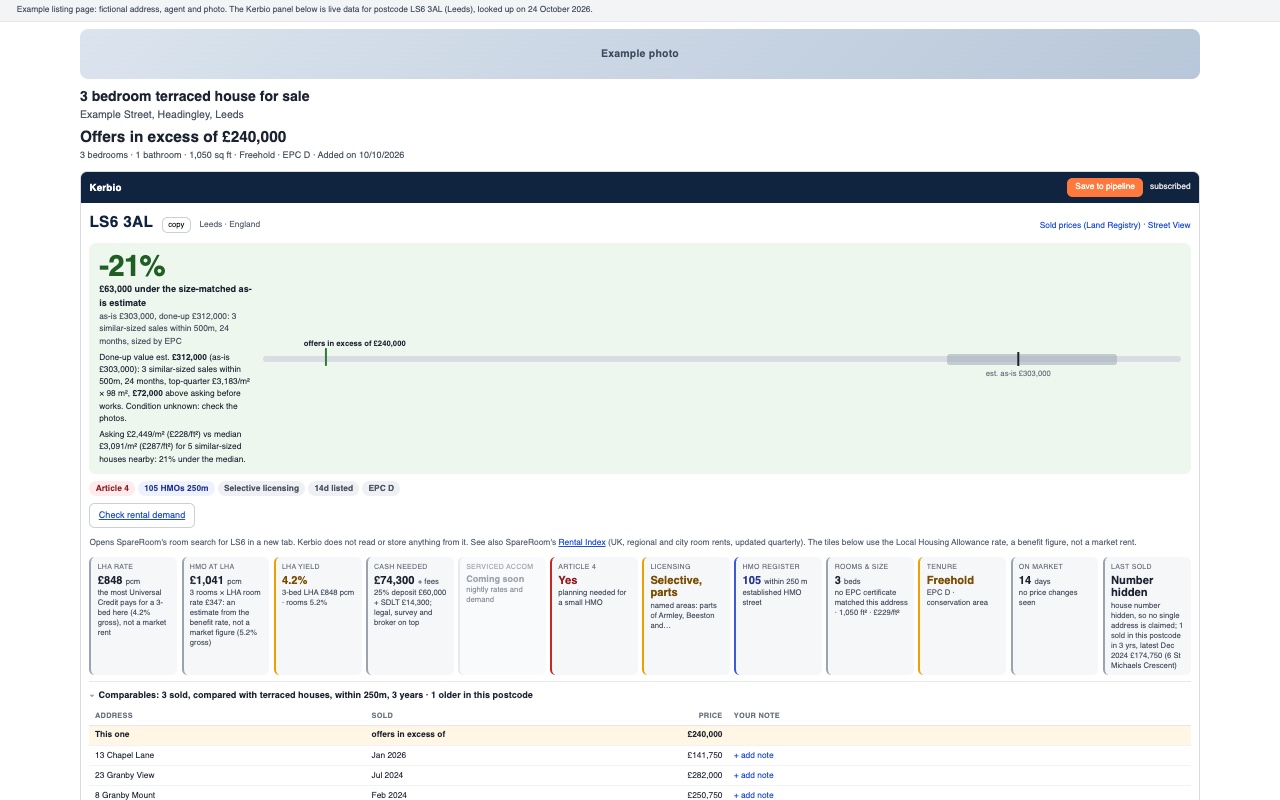
Sources
- MHCLG consultation page: Extending Awaab's Law to private rented tenancies and to licences (published 9 October 2026, closes 11:59pm 18 December 2026)
- The consultation document (sections 1 to 6, questions 1 to 64)
- Consultation-stage impact assessment (MHCLG, 39 pages)
- Respond online (Citizen Space)
- Awaab's Law: government response to the social rented sector consultation (timescales and phases)
- Awaab's Law: guidance for social landlords, timeframes for repairs (GOV.UK, updated 16 July 2026)
- Hazards in Social Housing (Prescribed Requirements) (England) Regulations 2025, regulations 2, 3 and 6 (definitions of working day, significant and emergency hazard, investigation period)
- Bank holidays in England and Wales (GOV.UK)
Checked on 2 November 2026. General information about a live consultation, not legal advice. The figures for private landlords are options under consultation; the social-sector figures are the law for social tenancies in England.