 Kerbio
If you run serviced accommodation, short lets or holiday lets in a mayoral area, this Bill would make you the collector of a new local tax. It is a percentage of the price of the stay, charged on the first 28 nights, paid to the strategic authority every quarter. The rate is set locally; ten mayors say no more than 5%. Small providers below a threshold pay nothing, but the threshold is not yet set. Nothing applies until Royal Assent, regulations and a published local prospectus, and no date exists for any of those. Ordinary tenancies are outside it.
Who pays, who collects, what is charged
The "levy rate" is the percentage rate at which visitor levy is charged, on the chargeable consideration in respect of qualifying stays in a chargeable period, as specified by the levying authority in the final visitor levy prospectus. Clause 4: the chargeable consideration is "the consideration payable for the occupation and reasonable enjoyment of the accommodation". The release: the government will continue to protect lower cost family breaks by requiring the levy to be charged as a percentage rate of the cost of accommodation, rather than as a flat fee.
Rate set locallyThe person liable to visitor levy in respect of a qualifying stay in local visitor accommodation is the accommodation provider. In this Act, the "accommodation provider", in relation to a qualifying stay, means the person who is required to bring consideration payable, under the agreement for the stay, for the occupation and reasonable enjoyment of the accommodation into account for the purposes of income tax or corporation tax. An agent or platform can collect, return and pay under clause 14, but the obligation stays with the provider.
Clause 5 and 14A "qualifying stay" occurs if, in respect of a period of no more than 24 hours, a person occupies local visitor accommodation as residential accommodation, for consideration payable under an agreement for that occupation, and pursuant to a licence to occupy the accommodation. A qualifying stay does not occur where the occupation is arranged or provided by a person exercising a statutory function (other than one prescribed), on a day falling immediately after a period of 28 successive days of occupation, or at any time when the provider knows or has reasonable grounds to believe the person will occupy the accommodation for 28 or more successive days.
Tenancies outsideAn accommodation provider is not liable to visitor levy for a chargeable period if the total chargeable consideration by reference to which the provider would be liable for that period does not exceed the levy threshold. The levy threshold is the greater of an amount prescribed in regulations, an amount specified by the levying authority in the final visitor levy prospectus (only if regulations authorise it), and nil. Associated providers are added together. Protections will ensure occasional hosts, such as people who only rent out a spare room from time to time, will only pay the levy if they earn above a set amount. Local leaders and mayors will also be able to adjust this threshold to reflect their local tourism market.
Amount not setWhat the Bill says, clause by clause
| Point | What the Bill as introduced says | Where |
|---|---|---|
| Who can impose it | A strategic authority, as defined in the English Devolution and Community Empowerment Act 2026, for qualifying stays in local visitor accommodation in its area. | Clause 1 |
| Chargeable periods | Quarters ending 31 March, 30 June, 30 September and 31 December. | Clause 2 |
| Rate | A percentage of the chargeable consideration, specified in the final visitor levy prospectus. | Clause 3 |
| What is charged | The consideration payable for the occupation and reasonable enjoyment of the accommodation. | Clause 4 |
| Who is liable | The accommodation provider: the person who brings the consideration into account for income tax or corporation tax. | Clause 5 |
| Threshold | No levy for a provider whose total chargeable consideration in the period does not exceed the levy threshold (regulations, or the authority's prospectus where regulations allow). Associated providers are added together. | Clause 6 |
| Accommodation covered | Accommodation occupied or offered as residential accommodation, including permanently sited vehicles and vessels and pitches for caravans and tents; institutional buildings, institutional student accommodation and authorised gypsy and traveller sites are out; regulations and local prospectuses can exempt more. | Clause 7 |
| Qualifying stay | Occupation as residential accommodation, for consideration, under a licence to occupy, within a 24-hour period. Not: stays arranged by a public body under a statutory function; the day after 28 successive days; any day once the provider knows the stay will be 28 days or more. | Clause 8 |
| Short-term rental register | Information sharing with the register of short-term rental properties. | Clause 13 |
| Agents and platforms | The liable person may arrange for another to collect, make returns (with the authority's consent) and pay; the arrangement does not affect the liable person's obligations. | Clause 14 |
| Enforcement | Schedule 3: recovery, repayments, interest, information and inspection powers, penalties, reviews and appeals; Schedule 4: offences of fraudulent evasion and misstatement. The release calls these standard tax powers, in line with national self-assessed taxes. | Clauses 10 to 12 |
| Commencement | Sections 16 to 21 and the regulation-making powers on the day the Act is passed; the rest on a day appointed by regulations. | Clause 20 |
The seven steps before any levy is charged
Schedule 1 and the release set the order. No area can charge until step 7, and the Bill itself needs Royal Assent and commencement regulations first.
- 1Initial prospectusrate, threshold, exemptions, first day
- 2Proposal and impact assessmentreasons, spending plans, effect on businesses and visitors
- 3Consultationresidents and businesses; members can propose changes
- 4Agreement in the authorityunanimous in a Foundation Strategic Authority
- 5Report on responsespublished
- 6Final prospectuspublished; the first chargeable day must be after it
- 7Levy runsquarterly returns; annual report on money raised and spent
What it means for a serviced accommodation operator
You collect with each booking and pay the authority once a quarter, so you hold the levy for up to three months. At 5% on a £120 night, that is £6 a night set aside; the calculator does the arithmetic for your rate, nights and occupancy.
Whether you show the levy as a separate line or absorb it is a commercial choice the Bill does not make for you. Holding net revenue at a 5% rate means a headline price about 5.3% higher (price divided by 0.95). How VAT interacts with the levy is not yet published.
Clause 14 lets a platform or managing agent collect and pay for you, but only with an arrangement in place, and the liability stays yours. No platform has said what it will do; treat "Airbnb will handle it" as unknown until one does.
How it already works in Scotland and Wales
| Nation | Law | What is charged |
|---|---|---|
| Scotland | Visitor Levy (Scotland) Act 2024 (asp 8), amended by the Visitor Levy (Amendment) (Scotland) Act 2026 (asp 18) | Edinburgh's levy is a 5% payment on the cost of the paid, overnight accommodation, charged before VAT, only on the first 5 nights' stay, for stays from 24 July 2026 onwards; stays booked and paid for, in part or full, before 1 October 2025 are not subject to it. (City of Edinburgh Council) |
| Wales | Visitor Accommodation (Register and Levy) Etc. (Wales) Act 2025 (asc 5) | Section 32: the lower rate is £0.75 and the higher rate is £1.30, subject to any additional amount a principal council may add under section 34; section 32 has been in force since 19 September 2025. Which accommodation pays which rate, that the rates are per person per night, and the first date a Welsh council can charge were not read from the Act or gov.wales for this page (the gov.wales rates page could not be fetched). |
| England | Visitor Levy (England) Bill, Bill 177, as introduced | A percentage rate set locally, first 28 nights, provider liable, quarterly. Nothing in force. |
What is not stated, as of 17 November 2026
- Any start date. Clause 20 brings the operative provisions into force by regulations, and Schedule 1 charges nothing until an authority publishes a final prospectus with a first chargeable day after that; neither the Bill nor the release gives a date.
- The occasional-host threshold amount. Clause 6 leaves it to regulations and, where allowed, to the levying authority's prospectus.
- Which areas will adopt a levy, or at what rate. Ten mayors are quoted in the release and have pledged no more than 5%; the rate is set locally in the final prospectus.
- How VAT interacts with the levy. Neither the Bill nor the release says; Edinburgh charges its levy before VAT, which says nothing about England.
- Whether booking platforms will collect the levy. Clause 14 allows a provider to arrange for another person to collect, return and pay on its behalf, but the obligation stays with the provider; no platform has said anything the page can quote.
Questions
Does the levy apply to my buy-to-let or HMO tenants?
No. Clause 8 defines a qualifying stay as occupation for consideration "pursuant to a licence to occupy", and it stops on the day after 28 successive days of occupation or as soon as the provider knows the stay will last 28 days or more. An assured tenancy is a tenancy, not a licence, and runs past 28 days. The levy is aimed at hotels, short lets, serviced accommodation and holiday lets.
Who is liable, the owner or the agent?
Clause 5: the person liable is the "accommodation provider", defined as the person who has to bring the consideration for the stay into account for income tax or corporation tax, so the owner or operator whose income it is. Clause 14 lets that person arrange for someone else, such as a managing agent or a platform, to collect, return (with the authority's consent) and pay on their behalf, but says the arrangement "does not affect any obligation" of the liable person. Landlord Today's report that a managing agent takes on the duty is therefore not what the Bill says; the agent can do the work, the liability stays with the provider.
What rate will it be?
Not set. Clause 3 makes the rate a percentage of the chargeable consideration, fixed by each levying authority in its final prospectus. The release says ten mayors "have committed that any levy introduced in their areas would be no higher than 5%". Our calculator defaults to 5% for that reason and lets you change it.
Is there a threshold for small or occasional hosts?
Yes in principle, no figure yet. Clause 6 exempts a provider whose total chargeable consideration in a quarter does not exceed the levy threshold, which is the greater of an amount set in regulations and, where regulations allow, an amount the authority sets in its prospectus. Associated providers are added together. The release calls this the protection for occasional hosts; the amount is not stated.
When would it start?
There is no date. Clause 20 brings the operative provisions into force by regulations after Royal Assent; Schedule 1 then charges nothing in an area until the strategic authority has published an initial prospectus, a proposal and an impact assessment, consulted, published a report on the responses and then published a final prospectus naming the first chargeable day. The earliest levy depends on Royal Assent and on each authority's timetable.
How often would I pay?
Clause 2 sets quarterly chargeable periods ending 31 March, 30 June, 30 September and 31 December, with returns and payment under Schedule 2. The release promises guidance on registering, paying and reporting; it is not published yet.
What is exempt?
From the release: student accommodation, care homes, children's homes and school boarding houses nationally; temporary accommodation, shelters and refuges are not charged; mayors may add limited local exemptions such as camping pitches. From clause 7: institutional buildings and institutional student accommodation as defined in the Finance Act 2019, authorised gypsy and traveller sites, and premises exempted by regulations or, within prescribed descriptions, by the authority's prospectus. Clause 8 also excludes stays arranged by a public body exercising a statutory function, which is how temporary accommodation falls out.
Is this tax advice?
No. It describes a Bill before Parliament, quoting its clauses and the government's release. Nothing here applies yet, and the Bill can change.
About this guide
Written by Kerbio, a small independent UK tool for property investors, on 17 November 2026 from the Bill as introduced, Parliament's Bills record and the government's release of 4 November 2026. Clause numbers are from the Bill text; the gaps are labelled. Not tax or legal advice.
Kerbio is a Chrome extension that puts sold prices, Article 4, licensing and the council's HMO register on the listing you are reading.
See the extension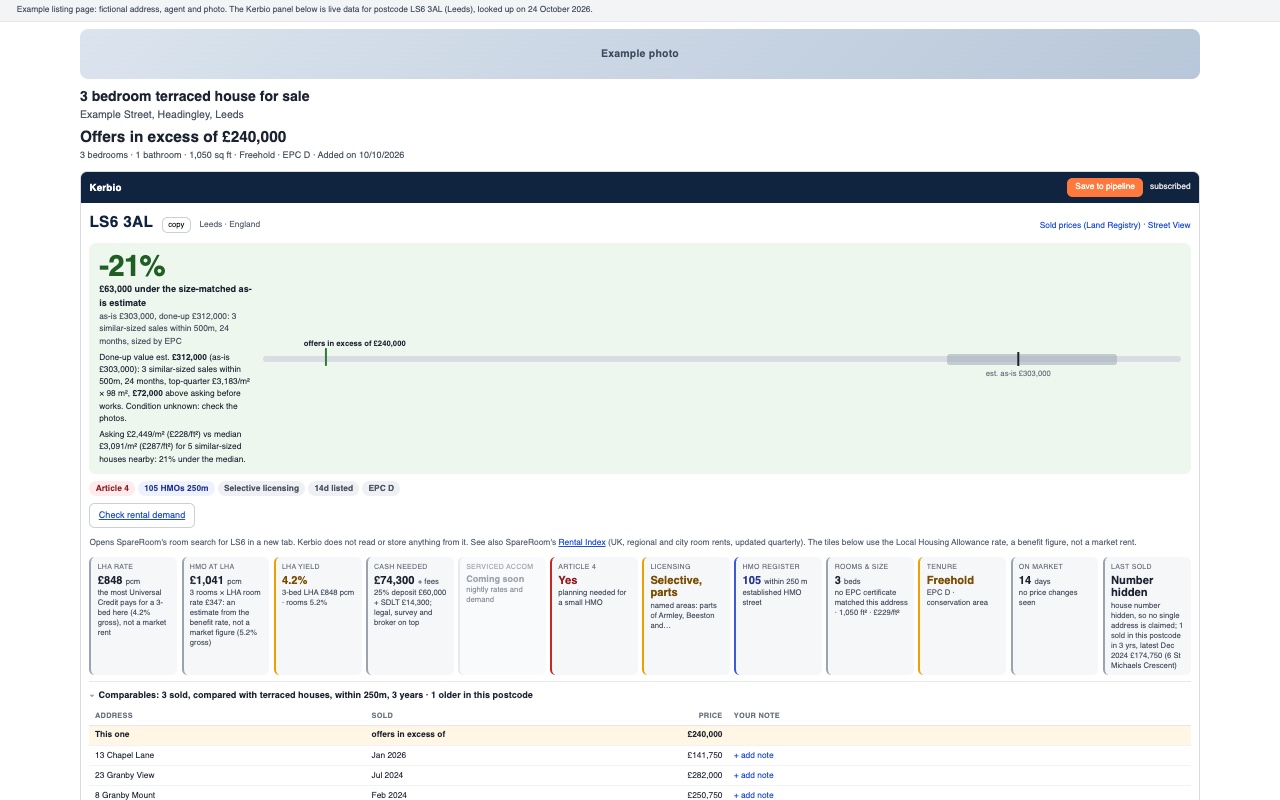
Sources
- Visitor Levy (England) Bill, Bill 177, as introduced (Parliament, 4 November 2026); explanatory notes (PDF)
- The Bill's page on bills.parliament.uk (stages: First Reading 4 November 2026; Second Reading passed on 16 November 2026, Ayes 296, Noes 96 (Commons Division 122, 21:58); Division 122)
- New visitor levy powers to put money back into local communities (MHCLG press release, 4 November 2026)
- About the Edinburgh Visitor Levy (City of Edinburgh Council); Visitor Levy (Scotland) Act 2024
- Visitor Accommodation (Register and Levy) Etc. (Wales) Act 2025, section 32
- Secondary, not relied on for any figure: Landlord Today, 9 November 2026
Checked 17 November 2026. The quotations are in SOURCES.txt. General information, not tax or legal advice.