 Kerbio
Nothing has changed in law. Ofgem is consulting on how suppliers handle a change of occupier, and the Government has said it will legislate, at some unfixed point, to make landlords tell suppliers about move-ins and move-outs, with liability for the property's energy charges only where neither the tenant nor the landlord gave that information. The press line "landlords to pay tenants' energy bills" comes from that strategy sentence; the document itself says the reform "may take some time". What a landlord can do today is the same as good practice already: record readings with a dated photo at every handover, tell the supplier who is in and who is out, and check the meter's mode and credit before a new tenant moves in, because under the draft guidance a smart meter in a void may have been switched to pay-as-you-go. The 9 December 2026 deadline is the chance to tell Ofgem what that looks like in an HMO.
What is proposed, what is reported, what is law
Guidance for suppliers
- Applies only where a working SMETS1 or SMETS2 smart meter is installed (draft guidance 1.3, 1.6).
- Switch to smart pay-as-you-go only when the outgoing customer has given a move-out date and no new customer has made contact (1.6).
- Site must pass the "safe and reasonably practicable" test; the supplier must look for signs of vulnerability first (1.7 to 1.15).
- The draft guidance says the new customer should be given a reasonable time to contact the supplier before the meter runs out of credit, the initial grace period, and that a period of 2 weeks, which the supplier may extend, gives the customer the opportunity to set up an account (paragraphs 1.21 and 1.22). The grace period should begin on the customer's move out date immediately following the switch to SPAYG. This does mean that, if a property is vacant for a long period after a remote switch, the meter may not have credit when the new customer moves in (paragraph 1.23).
- No new licence conditions; Ofgem "cannot place specific requirements on housing providers" (3.29).
- Closes 9 December 2026; outcome Spring 2027.
Landlord duty and liability
- The strategy: "Government will introduce legislation to Parliament to reform the home moves process, placing a new obligation on landlords to provide timely and accurate information to their supplier when tenants move into or out of a property."
- "Where neither the tenant nor landlord has provided the necessary information, landlords may become liable for energy charges associated with the property."
- Ofgem's consultation repeats it: "As set out in the energy debt circuit breaker, when parliamentary time allows DESNZ will legislate to reform the home moves process, placing a new obligation on non-resident owners (i.e. landlords) to provide timely and accurate information when tenants move into or out of a property. Where neither the tenant nor landlord has provided the necessary information, landlords will be jointly and severally liable for energy charges associated with the property, unless exempt."
- Timing: "when parliamentary time allows"; the strategy says the reform "may take some time to come into effect" and promises further engagement with landlord groups on the detail.
- Not in the Energy Independence Bill as introduced on 4 November 2026; no draft clause, no date.
Deemed contracts
- Electricity: where a supplier supplies premises otherwise than under a contract, it is 'deemed to have contracted with the occupier (or the owner if the premises are unoccupied) for the supply of electricity' from the time the supply began (Electricity Act 1989, Schedule 6, paragraph 3).
- Gas: a supplier that supplies gas to a consumer otherwise than under a contract is 'deemed to have contracted with the consumer for the supply of gas' from the time the supply began (Gas Act 1986, Schedule 2B, paragraph 8).
- A tenant who pays the bills is the supplier's customer during the tenancy; an owner can already be the deemed customer for an empty property.
- Nothing requires a landlord to notify an energy supplier of a change of occupier.
The figures the documents give
| Figure | Source, in its words |
|---|---|
| £5.02bn | Debt has tripled since 2022 and sat at £5.02bn as of Q2 2026. More than 2 million households are now in energy debt and arrears and less than half of these households have a repayment arrangement in place (DESNZ and Ofgem strategy, 28 October 2026). |
| 20% to 40% | Ofgem estimates that 20-40% of energy debt is associated with changes in occupancy, driven both by uncertainty over who new occupiers of a property are and consumers leaving properties without clearing outstanding balances (strategy, 28 October 2026). |
| 67% | The majority (67%) of home moves in England, in 2024/25, involved someone moving in or out of privately rented accommodation. Private renters move more frequently than owner occupiers, and social housing providers also manage large numbers of tenancy changes, with 16% of home moves involving a move in or out of the social rented sector. This is compared to 40% of moves involved owner occupier housing (consultation, paragraph 3.25, citing the English Housing Survey 2024 to 2025). |
| £1,872 and £1,613 | Over the past three years, rising energy costs have driven a significant increase in household arrears, now averaging £1,872 for electricity and £1,613 for gas per account without a repayment plan, up 9.1% and 8.4% respectively on the previous year (consultation, paragraph 1.5). |
Press reports of "£6bn" and "£11bn" are not in either document and are not used here.
What to do now
At every move-in and move-out, read every meter with the tenant, photograph the display with the date visible, and keep both readings with the tenancy file. The printable checklist has the fields.
Tell the supplier who is leaving and who is arriving, with the dates. Nothing requires it yet, but it is the information the Government says it will one day require, and it stops an unnamed account building a bill in a void.
Before handover, check the smart meter's mode and credit. Under the draft guidance a meter in a void may have been switched to pay-as-you-go with a two-week grace period that started on the previous tenant's move-out date; a long void can leave it out of credit on day one.
In a bills-included HMO, keep the account in your name throughout and say so in the tenancy agreement; the home moves process applies to changes of account holder, not to room changes under one account.
Respond to Ofgem by 9 December 2026 at debtstrategy@ofgem.gov.uk: question 4 asks about landlords and housing associations, 6 and 7 about the grace period, 9 and 10 about what notification arrangements would do.
Timeline
- December 2025Ofgem call for input on tackling energy debt when moving home.
- 28 October 2026DESNZ and Ofgem publish the energy debt strategy; Ofgem opens this consultation the same day.
- 9 December 2026Consultation closes.
- Spring 2027, expectedOfgem decision or policy statement on the guidance (consultation stages).
- "When parliamentary time allows"Legislation on the landlord duty; no Bill, no date. The same phrase covers the planned tenant right to a smart meter without landlord consent.
Not stated, as of 20 November 2026
- When the landlord duty would be legislated: 'when parliamentary time allows'; it is not in the Energy Independence Bill introduced on 4 November 2026, and no other Bill carries it.
- What 'timely and accurate information' would mean, how it would be given, and what the exemptions ('unless exempt') would be.
- Whether liability would be joint and several (Ofgem's consultation, paragraph 3.33) or 'may become liable' (the strategy); the two documents use different words.
- Whether social landlords would face different liability rules: the strategy says it 'will consider' that.
- What Ofgem will decide on the guidance; its own timetable says a decision or policy statement in Spring 2027.
- Any figure for debt caused by home moves beyond the 20% to 40% range: the press figures of £6bn and £11bn are not in the documents.
Questions
Will I have to pay my tenants' energy bills?
Not under any law in force. The Government's strategy of 28 October 2026 says: "Where neither the tenant nor landlord has provided the necessary information, landlords may become liable for energy charges associated with the property." That is a statement of intent for legislation "when parliamentary time allows"; there is no Bill, no clause and no date, and the strategy itself says the reform "may take some time to come into effect". The obligation described is to give the supplier timely and accurate information at move-in and move-out; the liability described would arise only where neither the tenant nor the landlord did so, "unless exempt" in Ofgem's words. Ofgem's consultation cannot impose any of this: it says it "cannot place specific requirements on housing providers through energy supply licence conditions" (paragraph 3.29).
What is Ofgem actually consulting on?
Guidance for energy suppliers, not rules for landlords. In Ofgem's words, the consultation asks for views on when a supplier may remotely switch a smart meter to smart pay-as-you-go mode as part of the home moves process, how suppliers should assess site and customer suitability before making a remote switch, what and how suppliers communicate with new customers, mechanisms for customer protection including a grace period after the switch is made, and how Ofgem will monitor customer outcomes. The guidance applies only where a working smart meter is already installed; it introduces no new licence conditions; the consultation closes on 9 December 2026 and Ofgem expects a decision in Spring 2027.
What happens to the meter in a void?
On the draft guidance, once the outgoing customer gives a move-out date and nobody new has made contact, the supplier may remotely switch a working SMETS1 or SMETS2 smart meter into smart pay-as-you-go mode after checking the site is safe and suitable and looking for signs of vulnerability (paragraphs 1.6 to 1.15). The draft guidance says the new customer should be given a reasonable time to contact the supplier before the meter runs out of credit, the initial grace period, and that a period of 2 weeks, which the supplier may extend, gives the customer the opportunity to set up an account (paragraphs 1.21 and 1.22). The grace period should begin on the customer's move out date immediately following the switch to SPAYG. This does mean that, if a property is vacant for a long period after a remote switch, the meter may not have credit when the new customer moves in (paragraph 1.23). So a meter in a long void could be out of credit when the next tenant arrives, which is why the checklist below has you check the meter mode and credit before handover.
Who is liable for energy used in an empty property today?
Electricity: where a supplier supplies premises otherwise than under a contract, it is 'deemed to have contracted with the occupier (or the owner if the premises are unoccupied) for the supply of electricity' from the time the supply began (Electricity Act 1989, Schedule 6, paragraph 3). Gas: a supplier that supplies gas to a consumer otherwise than under a contract is 'deemed to have contracted with the consumer for the supply of gas' from the time the supply began (Gas Act 1986, Schedule 2B, paragraph 8). In plain terms, while a let property is empty the owner is generally the deemed customer for electricity, and may be for gas; while a tenant is in occupation and pays the bills, the tenant is. The proposed reform would go further by attaching liability to a landlord who failed to give information during a tenancy; that is the part that does not exist yet.
Why does Ofgem mention the water rules?
The strategy says the reform "would place similar obligations on landlords as exist with respect of water bills" and Ofgem's consultation refers to landlord notification arrangements in water in Wales (questions 9 and 10). Water law already requires an owner to give the water company occupier information in some cases. This page does not set out the water rules; it notes the comparison the documents draw.
What should a landlord say to Ofgem?
Ofgem lists landlords and housing associations among those who should respond, by email to debtstrategy@ofgem.gov.uk by 9 December 2026. Its questions include Q4 on the proposed approach to landlords and housing associations, Q6 and Q7 on whether the two-week grace period is enough and who should pay for it, and Q9 and Q10 on what landlord notification arrangements, if introduced, would do to debt recovery and costs. Evidence from HMO operators with frequent room turnover, bills-included lets and void periods is the kind the consultation asks for.
Is this advice?
No. It states what Ofgem's consultation, the draft guidance and the Government's strategy say, with paragraph references, and what the law says today. Energy supply contracts, deemed contracts and any future duty depend on the facts of each property; check with the supplier or an adviser.
About this guide
Written by Kerbio, a small independent UK tool for property investors, on 20 November 2026 from Ofgem's consultation document and draft guidance (both read in full), the DESNZ and Ofgem strategy on gov.uk, and the deemed contract provisions on legislation.gov.uk. Quotations are the documents' own words with paragraph numbers. An explainer, not legal advice.
Kerbio is a Chrome extension that puts sold prices, Article 4, licensing and the council's HMO register on the listing you are reading.
See the extension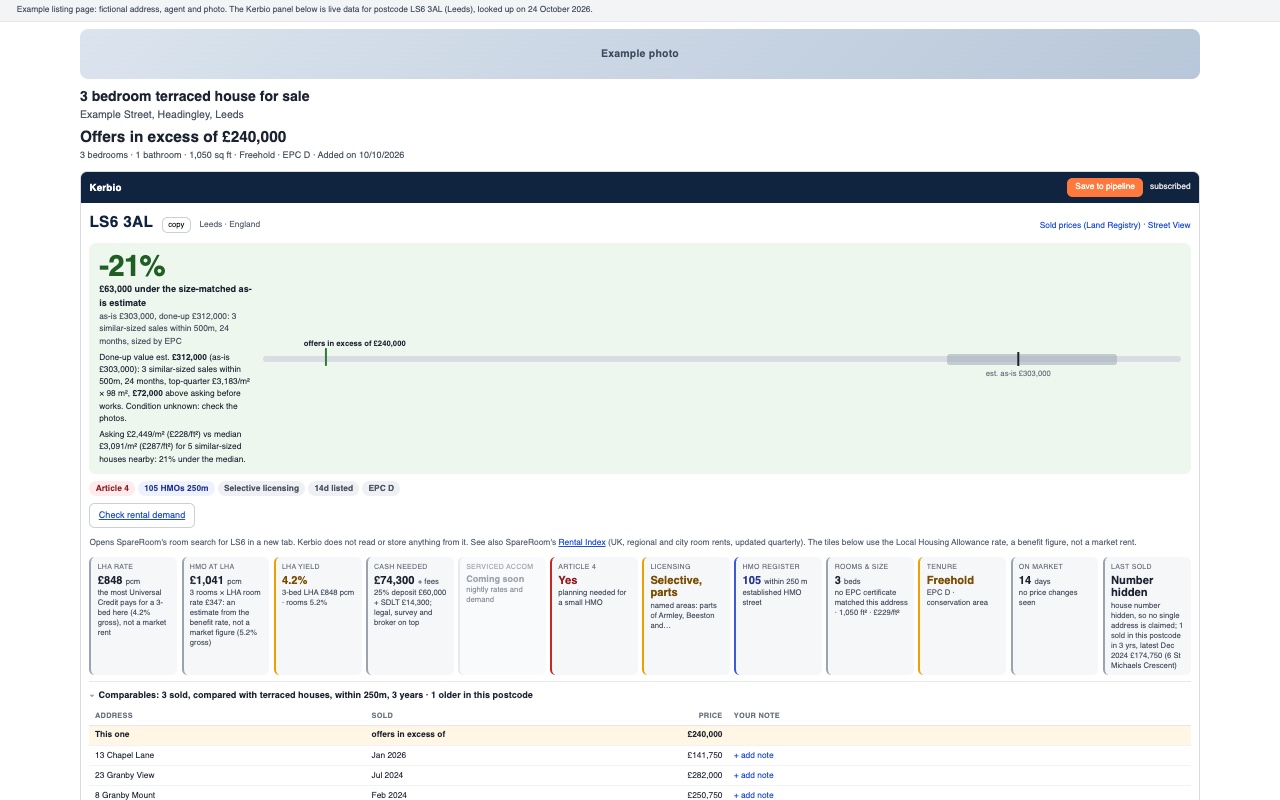
Sources
- Proposed moving home process guidance (Ofgem consultation page, published 28 October 2026); consultation document (PDF, 52 pages); draft deemed contracts guidance: moving home (PDF)
- Energy debt circuit breaker: a strategy for domestic energy debt (DESNZ and Ofgem, 28 October 2026)
- Electricity Act 1989, Schedule 6, paragraph 3; Gas Act 1986, Schedule 2B, paragraph 8 (legislation.gov.uk)
- Tackling energy debt when moving home (Ofgem call for input, December 2025)
- Secondary, not relied on for any figure: Property118, 20 November 2026
Checked 20 November 2026. Quotations in SOURCES.txt. Great Britain. General information, not legal advice.