 Kerbio
If your lets are in your own name on ordinary plots, nothing changes. If they are in a limited company, anyone could read the title registers for free (ownership data already is). If you hold half a hectare or more on one title, your name could appear in a searchable public dataset, depending on the threshold chosen. Sourcers get free company-owned title data but not bulk scraping. The document estimates a further £22 million to £41 million a year for the economy from the new dataset. Views are open until 22 December 2026.
What is proposed
HM Land Registry, the Ministry of Housing, Communities and Local Government and the Department for Environment, Food and Rural Affairs published the consultation on 27 October 2026 (updated 5 November 2026). It applies to England and Wales. The five proposals, in the document's words:
- Publish a new dataset of the owners of significant land holdings on the register.
- Give public sector users cost-free access to information held on HMLR title registers.
- Give all users cost-free access to information held on HMLR title registers relating to commercially owned and significant land holdings.
- Extend public sector access to other users with public interest objectives.
- Accelerate completion of the register of title by exploring options such as linking government land use payments to registration of the land.
Alongside them, the government is also seeking views on whether HMLR should have powers to suppress or restrict access to information in limited circumstances where there is clear evidence of risk.
Today against the proposals
| Item | Today | Proposed |
|---|---|---|
| Title register inspection (read what the register says) | £7 per title online, for everyone | £7 stays for private individuals; free for public sector users for information purposes; free for titles linked to the company-owned and significant-holdings datasets |
| Official Copies for legal transactions | Fee per copy | Unchanged |
| Ownership of company-owned land (about 16% of titles) | Free under licence since 2016 (UK and overseas companies) | Unchanged, plus free viewing of the linked title registers |
| Owners of significant land holdings | No dataset | New dataset: free under licence, published monthly, searchable by owner name; threshold between 0.5 and 20 hectares under consultation |
| Bulk access and automated extraction | HMLR terms and conditions apply | "Proportional limits on access, for example restricting bulk access"; automated extraction and republication not permitted |
| Suppression where there is a risk of harm | No general power | Powers to suppress or restrict access in limited circumstances, consulted on (questions 30 to 32); would need legislation |
The thresholds in the document
| Threshold | Proportion of all HMLR titles | Proportion of all registered land | Proportion of titles containing a single home (1) |
|---|---|---|---|
| Greater than or equal to 0.5 hectares | 6.5% | 94.5% | 1.6% |
| Greater than or equal to 1 hectare | 4.9% | 92.8% | 1.1% |
| Greater than or equal to 5 hectares | 2.0% | 83.3% | 0.4% |
| Greater than or equal to 10 hectares | 1.2% | 75.3% | 0.3% |
| Greater than or equal to 20 hectares | 0.7% | 63.7% | 0.2% |
Note: This table does not take into account land for which the owner's details are already in public datasets on UK and Overseas companies that own property in England and Wales.
(1) Around 71% of HMLR titles contain a single residential address. Some are owned by companies and/or rented, however, we can assume that most of these titles are owner-occupied. This column explains what proportion of these titles would be included in the significant landholdings data at each threshold.
Does this affect me
No change. The £7 fee stays for anyone wanting to read your title, and your name is not in any new dataset unless the title is at or above the chosen threshold.
No changeCompany ownership has been in a free dataset since 2016. Under the proposal the full title register for that property would be free to view by anyone, with bulk limits.
Free to viewYour name could appear in the significant land holdings dataset, searchable by name and published monthly. Whether single-home titles get a higher threshold is question 10.
Depends on the thresholdCompany-owned titles become free to check one at a time; bulk access would be limited and automated extraction or republication not permitted. Price paid data is not mentioned.
Read, not harvestWhat is not stated, as of 8 November 2026
- Which fields would be published for an individual owner in the significant land holdings dataset beyond the name; the document says the dataset would be searchable by owner name.
- Whether price paid data or the existing bulk commercial licences change: the document does not say.
- The threshold that will be adopted: the five figures in Table 1 are illustrative and question 9 asks which.
- When any change would take effect: suppression powers would need legislation; no dates are given.
How to respond by 22 December 2026
The questions most likely to matter to a landlord or investor, in the document's wording. This page does not suggest answers.
- Q6To what extent do you support the proposal for HMLR to publish a new open dataset of the owners of significant land holdings?
- Q7What benefits might come from publishing a new public dataset of owners of significant land holdings on the register?
- Q8What risks might come from publishing this data?
- Q9What minimum area threshold would be the most appropriate to adopt to balance the usefulness of the data against privacy and data protection impacts?
- Q10Should titles containing a single residential address be subject to a higher minimum threshold than other titles?
- Q11What alternatives could achieve these policy objectives which increase the benefits while reducing risks?
- Q16To what extent do you agree with allowing cost-free access to information held on all HMLR title registers linked to properties in the UK and Overseas Companies dataset?
- Q17To what extent do you agree with allowing cost-free access to information held on all HMLR title registers for the properties linked to the significant land holdings dataset described above?
- Q18What benefits might come from providing all users with controlled cost-free access to title registers, such as a PDF, rather than just data with owners' names?
- Q19What risks or unintended consequences might come from providing all users with controlled cost-free access to title registers, such as a PDF, rather than just data with owners' names?
- Q30To what extent do you agree with the proposal that HMLR introduce safeguards in limited circumstances where publication creates a significant risk of harm?
- Q31To what extent do you agree with the proposal that HMLR have powers to suppress or restrict access to information in limited circumstances where access creates a significant risk of harm?
- Q35Do you consider there to be any risks of these proposals relating to impacts on specific protected characteristics?
Questions
Will I still pay £7 to look at a title?
For most titles, yes. The £7 online inspection fee stays for private individuals looking at ordinary homes. The proposals make title registers free to view where the title is linked to the company-owned dataset or the new significant land holdings dataset, and free for public sector users for information purposes. Official Copies for legal transactions keep their fees.
My buy-to-let is in a limited company. What changes?
Ownership of company-owned land (about 16% of titles) has been free under licence since 2016. The new proposal is that the title registers linked to those titles become free to view as well, with proportional limits on bulk access and no automated extraction or republication. Anyone could read your company's title register without paying.
Would my name be published?
Only if you hold land at or above the threshold adopted for the significant land holdings dataset, which the consultation puts between 0.5 and 20 hectares. At 0.5 hectares the dataset would cover 1.6% of titles containing a single home; at 20 hectares, 0.2%. Question 10 asks whether single-home titles should get a higher threshold. The fields beyond the owner's name are not stated.
Can sourcers scrape the free title registers?
The document proposes "proportional limits on access, for example restricting bulk access", and says automated extraction and republication of data from title registers will not be permitted, in line with HMLR's normal terms. Free to read, not free to harvest.
What are the suppression powers?
The government asks whether HMLR should be able to suppress or restrict access to information in limited circumstances where there is clear evidence of risk, listing personal safety, harassment, domestic abuse, fraud, national security and others (questions 30 to 32). Such powers would need legislation. Interim safeguards named are user authentication; monitoring and audit arrangements; limits on bulk access; restrictions on automated extraction; allowing opt outs for vulnerable individuals; or terms and conditions governing reuse.
How do I respond?
Online at the survey link, by email to futureaccessconsultation@landregistry.gov.uk, or by post to Policy Team, HM Land Registry, 7th Floor, Trafalgar House, 1 Bedford Park, Croydon CR0 2AQ, by 11:59pm on 22 December 2026. Answer only the questions that matter to you; the guide lists the ones that touch landlords and investors.
About this guide
Written by Kerbio, a small independent UK tool for property investors, on 8 November 2026 from the consultation document and its gov.uk page. Every figure is in the document; the gaps are labelled. Not legal advice, and no view on how to answer.
Kerbio is a Chrome extension that puts HM Land Registry sold prices, Article 4, licensing and the council's HMO register on the listing you are reading.
See the extension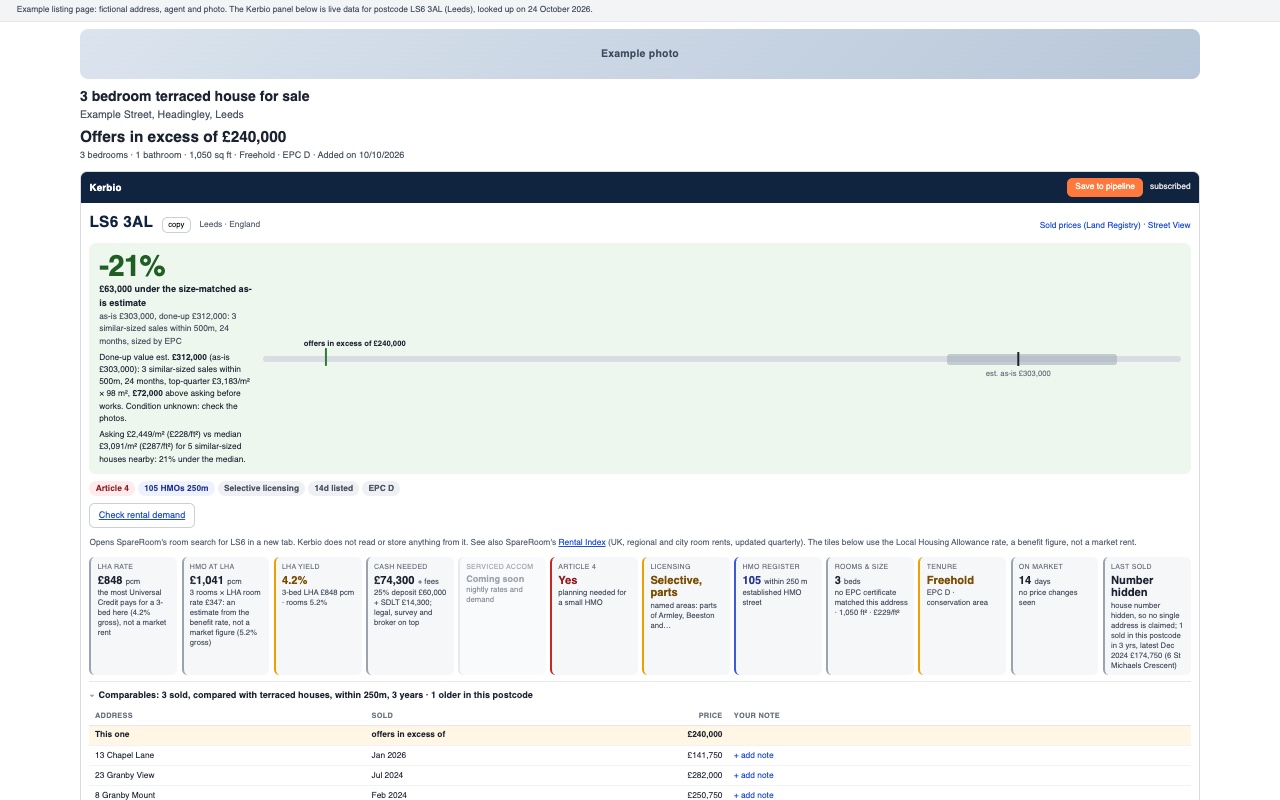
Sources
- Consultation: Future of access to HM Land Registry information (HMLR, MHCLG and Defra, 27 October 2026, updated 5 November 2026)
- Consultation page on gov.uk, with the closing date and ways to respond
- Online survey
Checked 8 November 2026. The quotations and figures are in SOURCES.txt. General information, not legal advice.