 Kerbio
Nothing changes today. The standard is still EPC E and the most a council can fine you is £5,000 per property. The Bill, published with factsheets on 4 November 2026, would raise the maximum to £30,000, bring HMOs inside the regulations and make councils report their enforcement, all "in time for" EPC C on 1 October 2030. Your spend to reach C is capped at £10,000 per property; a home that still falls short after that can be let under a 10-year exemption.
What the Bill does
The measure will introduce a new maximum civil penalty of £30,000 for landlords found to be in breach of the Energy Efficiency (Private Rented Property) (England and Wales) Regulations 2015. The factsheet's reason: to make sure the civil penalty for non-compliance is larger than the updated proposed maximum required investment per property of £10,000 confirmed in the government response published 21 January 2026.
Factsheet, 4 November 2026The measure will ensure houses in multiple occupation can be required to comply with the Energy Efficiency (Private Rented Property) (England and Wales) Regulations 2015. Today the regulations cover a home that needs an EPC and is let on an assured tenancy, a regulated tenancy or a domestic agricultural tenancy; many room-by-room lets sit outside.
FactsheetThe measure will introduce a requirement for enforcement authorities to report enforcement action. The factsheet says pilots showed secondary legislation alone was not enough without "enhanced enforcement and compliance powers" in primary legislation; it does not list the powers.
FactsheetThe measure also includes a provision to require properties let on a licence to occupy type arrangement (such as short-term lets) to comply with the Energy Efficiency (Private Rented Property) (England and Wales) Regulations 2015; however, government has no plans to exercise these powers at this time.
Not in useThe timeline
- 1 April 2018EPC E for new tenancies2015 Regulations; gov.uk guidance
- 1 April 2020EPC E for all existing lets, £3,500 capgov.uk guidance
- 21 January 2026EPC C from 1 October 2030 confirmed, £10,000 cap, 10-year exemptionsGovernment response
- 4 November 2026Bill factsheets: £30,000 penalty, HMOs, reporting dutyFactsheets; Bill introduced the same day
- 1 October 2030EPC C, or a valid registered exemption, to letResponse; C on the current EPC before 1 Oct 2029 counts until it expires
Today against the Bill
| Item | Today (2015 Regulations) | Under the Bill |
|---|---|---|
| Minimum standard | EPC E since 1 April 2020 (new tenancies since 1 April 2018) | EPC C from 1 October 2030, set by the 21 January 2026 response, not the Bill |
| Maximum penalty | £5,000 per property in total; up to £2,000 for letting a non-compliant property for less than 3 months; up to £4,000 for letting a non-compliant property for 3 months or more; up to £1,000 for false or misleading information on the exemptions register; up to £2,000 for failing to comply with a compliance notice (regulation 40) | £30,000 maximum civil penalty; per property or per breach not stated |
| Cost cap | £3,500 including VAT to reach E | £10,000 per property over 10 years to reach C (21 January 2026 response) |
| HMOs | Covered only where the home needs an EPC and is let on a qualifying tenancy; many room lets outside | Can be required to comply |
| Short-term lets and other licences to occupy | Outside the regulations | A power to bring them in; no plans to use it |
| Council reporting duty | None | Enforcement authorities must report enforcement action |
| Enforcement powers | Compliance notices, penalty notices, publication penalties | "Enhanced legal powers"; not listed in the factsheet |
What changes for an HMO
Where rooms are let on licences and the house has never needed an EPC, the 2015 Regulations do not bite today. The Bill is written to let government require HMOs to comply, so plan on the whole house reaching C by 1 October 2030.
Licensing and MEES are separate regimes run by the same council. A licence does not exempt the house from the energy standard, and the Bill gives the council a larger penalty and a reporting duty. See HMO licensing by council.
The £10,000 maximum required investment is per property, not per room; the factsheet does not say how an HMO's EPC will be assessed under the new metrics.
What is not yet stated, as of 8 November 2026
These points are not in the factsheets or the January response. Anyone quoting a figure for them is guessing.
- Whether the £30,000 maximum applies per property, per breach or per landlord. The factsheet gives the figure only; the 2015 Regulations cap today's penalties per property.
- Inspection, entry and notice powers: the factsheet speaks of 'enhanced legal powers' without listing them.
- The commencement date for the new penalty and the HMO extension. The factsheet says the powers are to be in place 'in time for' the EPC C standard.
- What 'reporting enforcement action' will require councils to publish, and how often.
- Whether short-term lets will ever be brought in: the power exists in the Bill, 'government has no plans to exercise these powers at this time'.
What to do now
Questions
Is the £30,000 penalty law yet?
No. It is in the Energy Independence Bill, whose factsheets were published on 4 November 2026. The Bill was introduced in the House of Commons on 4 November 2026 (first reading); no later stage scheduled when checked. Until it passes and the regulations are amended, the maximum under the 2015 Regulations stays at £5,000 per property in total.
Is it £30,000 per property or per breach?
The factsheet does not say. It gives the figure as the new maximum civil penalty for a landlord in breach of the 2015 Regulations. Today's maximums are set per property and per breach, with a £5,000 total per property; whether the new figure follows the same structure is not yet stated.
Does my HMO have to meet EPC C?
Today the 2015 Regulations cover a home that is legally required to have an EPC and is let on an assured tenancy, a regulated tenancy or a domestic agricultural tenancy. Many rooms let individually fall outside that. The factsheet says the Bill "will ensure houses in multiple occupation can be required to comply", so expect HMOs to come inside the rules before 1 October 2030. How an HMO's EPC is assessed under the new metrics is not set out in the factsheet.
What do I have to spend?
Under the 21 January 2026 government response, up to £10,000 per property over a 10-year period on relevant improvements. If the home still does not reach C after that spend, you can register an exemption valid for 10 years and keep letting. The impact assessment estimates an average spend of £5,400 per property once the cap is taken into account. Today's cap for the EPC E standard is £3,500 including VAT.
My home is already a C. Does anything change?
Private rented homes that are graded C or above against the Energy Efficiency Rating (EER) on EPCs before 1 October 2029 will be considered compliant with the higher standard until the EPC expires. After that date a new EPC on the reformed metrics is needed to show compliance, and the cost of those EPCs counts towards the cap.
Does this apply to short-term lets?
Not now. The Bill includes a power to require properties let on a licence to occupy, such as short-term lets, to comply, but the factsheet says the government has no plans to exercise that power at this time.
Is this advice?
No. It is what the government's own factsheets, the January 2026 response and the 2015 Regulations say, with the figures labelled by source. It is not legal or financial advice; the Bill can change as it goes through Parliament.
About this guide
Written by Kerbio, a small independent UK tool for property investors, on 8 November 2026 from the Bill's factsheets, the 21 January 2026 government response and the 2015 Regulations. Every figure is labelled with where it comes from; the gaps are labelled too. Not legal or financial advice.
Kerbio is a Chrome extension that puts sold prices sized by energy certificate, Article 4, licensing and the council's HMO register on the listing you are reading.
See the extension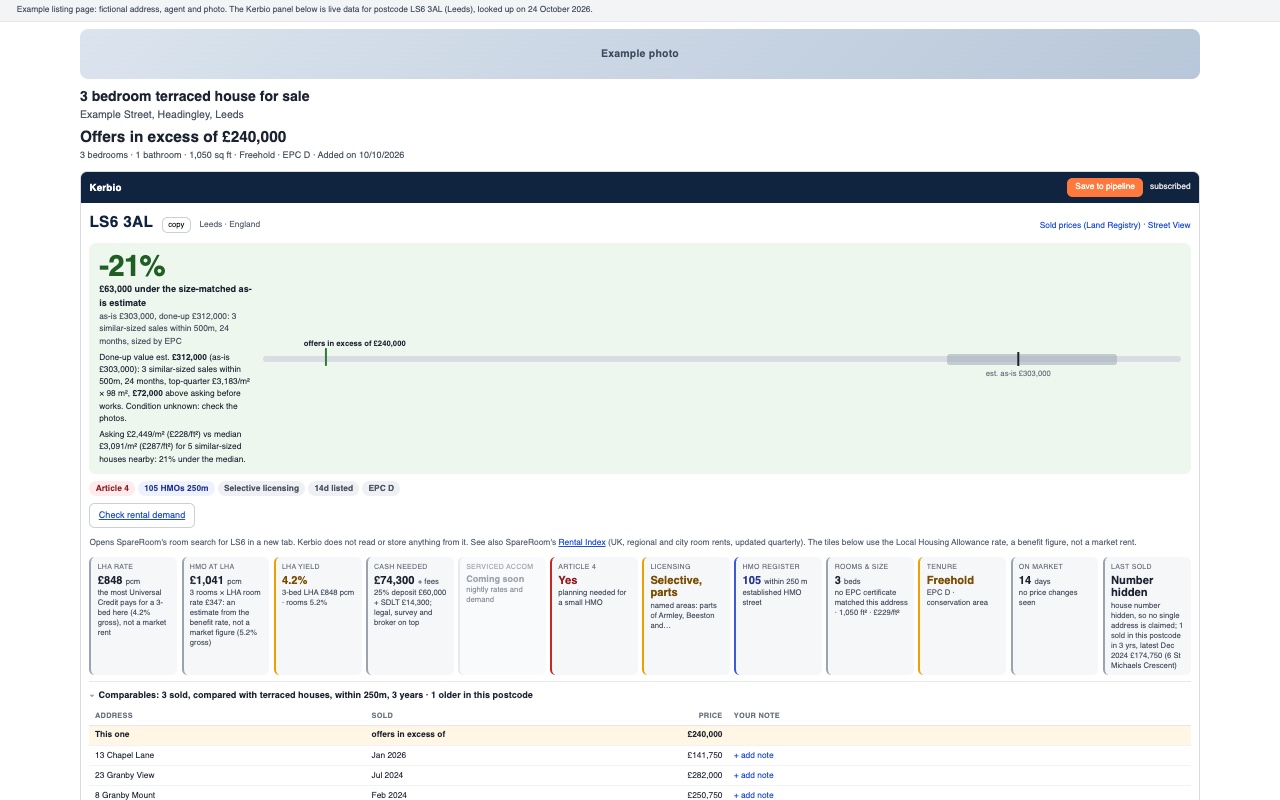
Sources
- Energy Independence Bill factsheet: domestic private rental sector minimum energy efficiency standards enforcement (DESNZ, 4 November 2026)
- Energy Independence Bill overview factsheet (4 November 2026)
- Improving the energy performance of privately rented homes: government response (21 January 2026, PDF)
- Domestic private rented property: minimum energy efficiency standard, landlord guidance (gov.uk)
- The Energy Efficiency (Private Rented Property) (England and Wales) Regulations 2015, regulation 40
- Energy Independence Bill, Parliament's bills page (Parliament's bills page (bills.parliament.uk, read through search results on 7 and 8 November 2026; the page refuses direct automated reads))
Checked 8 November 2026. The figures and the quotations are in SOURCES.txt. General information, not legal or financial advice.