 Kerbio
If you let a bills-included HMO, the energy you buy for it costs about 28% more from 1 January 2027 than in the last quarter of 2026, on Ofgem's capped rates. The unit rate for gas rises from 7.97p to 10.96p a kWh and electricity from 26.32p to 32.69p; standing charges barely move. On a five-room house using 5,000 kWh of electricity and 19,000 kWh of gas a year (Kerbio's assumption), that is £886 a year or £15 a room a month. The cap caps the rates, not the bill. Tenants in an HMO where the landlord pays the council tax are outside the core £100 Household Energy Payment; their council's discretionary fund can help them, up to £100, on criteria each council publishes.
The rates, both quarters
| Ofgem cap, GB average, direct debit | Oct to Dec 2026 | Jan to Mar 2027 | Change |
|---|---|---|---|
| Electricity, per kWh (no VAT in both periods) | 26.32p | 32.69p | +24% |
| Electricity standing charge, per day | 54.83p | 54.77p | -0.06p |
| Gas, per kWh (5% VAT included) | 7.97p | 10.96p | +38% |
| Gas standing charge, per day | 29.68p | 29.65p | -0.03p |
| Typical dual fuel household, annualised (2,500 kWh electricity, 9,500 kWh gas) | £1,723 | £2,166 | +26% |
VAT is not included in electricity bills for the period 1 January to 31 March 2027 (the UK government has removed VAT from electricity bills for 1 October 2026 to 30 June 2027); gas includes VAT at 5%. Ofgem's cap levels document shows the medium Typical Domestic Consumption Values the cap is calculated against: 2,500 kWh a year of electricity (single-rate metering) and 9,500 kWh a year of gas. Ofgem updated these values in July 2026; against the 2023 values the typical bill would read £1,935 rising to £2,451.
A five-room bills-included HMO, on a stated assumption
Assumption, not data: Kerbio's assumption, not an Ofgem figure: a five-room bills-included HMO on one gas and one electricity supply using twice Ofgem's typical household consumption, 5,000 kWh of electricity and 19,000 kWh of gas a year. Shared houses with five adults, five bedrooms heated and a kitchen in constant use commonly use more than one family home; the calculator takes your own meter readings instead.
| Five rooms, one gas and one electricity supply | Oct to Dec 2026 | Jan to Mar 2027 |
|---|---|---|
| Electricity: 5,000 kWh plus standing charge | £1,516 | £1,834 |
| Gas: 19,000 kWh plus standing charge | £1,623 | £2,191 |
| Total a year | £3,139 | £4,025 |
| Per room, per month | £52.31 | £67.08 |
| For the three months of the quarter, whole house | £785 | £1,006 |
Annual figures apply the quarter's rates for a full year, as Ofgem's typical figure does; the quarter row divides by four and ignores that winter use is higher than the yearly average. Water, broadband and council tax are not included. Use your own readings.
The £100 Household Energy Payment and HMOs
"To help households with the rising cost of energy, the government will provide a one-off £100 Household Energy Payment to households in council tax bands A to D from January 2027." Paid by councils from 4 January 2027, assessed on that day, scheme open to 31 May 2027. Not taxable.
£100, automatic where the council holds a direct debitNo core payment for anyone in the property. The guidance names tenants in HMOs where the landlord is liable for council tax first among the households a council could support from its discretionary fund, with awards up to £100 and criteria each council publishes, expected by 12 December 2026.
discretionary fund onlyWhere the sharers are themselves jointly liable for council tax and the home is in band A to D, it is an ordinary eligible household: the full £100 goes to the direct debit account, not split between them.
one payment per householdThis guidance applies to England only. The devolved governments will receive corresponding funding through the Barnett formula. The government is calling on the devolved governments to provide equivalent support to households in Wales, Scotland and Northern Ireland. a property that has no permanent resident and is someone's second home will not be eligible; an unoccupied property (for the purposes of calculating council tax) will not be eligible
Not stated, as of 25 November 2026
- Regional unit rates: the figures here are Ofgem's GB averages for direct debit; the levels PDF gives each region, and prepayment and standard credit rates differ.
- What a real HMO uses: the five-room example is a Kerbio assumption; use meter readings in the calculator.
- The cap for April to June 2027: due by 23 February 2027.
- When gas standing charges will go: the Government has asked Ofgem to remove them in 2027 or as soon as possible afterwards; no date.
- Each council's discretionary fund criteria: councils are expected to publish them by 12 December 2026; whether HMO tenants in a given council get anything depends on that scheme.
- Wales, Scotland and Northern Ireland: the £100 payment is England only; the devolved governments receive Barnett funding and are asked to provide equivalent support, with nothing fixed when checked.
Questions
Do HMO tenants get the £100 Household Energy Payment?
Not the core payment, where the landlord is the council tax payer. MHCLG's guidance to councils (24 November 2026) says: "where the billing authority is aware that the liable council tax payer for a chargeable dwelling does not occupy the property (for example in a House in Multiple Occupation or residential care home), no-one will be eligible for the Household Energy Payment in relation to that property. Billing authorities might consider supporting occupants in these circumstances through their discretionary fund" The core £100 goes to households in council tax bands A to D in England from 4 January 2027, assessed on 4 January 2027; a bills-included HMO where the landlord pays the council tax is outside it. The guidance then lists tenants in HMOs where the landlord is liable for council tax first among the households a council could help from its £100 million discretionary fund, with awards of up to £100; each council publishes its own criteria, expected by 12 December 2026. Where sharers hold a joint tenancy and are themselves jointly liable for council tax, the household is an ordinary band A to D household and the full £100 goes to the direct debit account, not split. England only: Wales, Scotland and Northern Ireland get Barnett funding and are asked to provide equivalent support.
What are the new cap rates?
From 1 January to 31 March 2027, GB averages for direct debit: electricity 32.69p per kWh and 54.77p a day standing charge, with no VAT; gas 10.96p per kWh and 29.65p a day, including 5% VAT. Ofgem: "The price cap limits the unit rates and standing charges suppliers can charge customers on default tariffs. It does not set a maximum total bill, so what people actually pay will depend on how much energy they use." Regional rates differ and are in Ofgem's levels document; prepayment and standard credit rates differ too.
How does Ofgem get to £2,166?
Ofgem's cap levels document shows the medium Typical Domestic Consumption Values the cap is calculated against: 2,500 kWh a year of electricity (single-rate metering) and 9,500 kWh a year of gas. Ofgem updated these values in July 2026; against the 2023 values the typical bill would read £1,935 rising to £2,451. Kerbio's check: 2,500 kWh at 32.69p plus 365 days at 54.77p, and 9,500 kWh at 10.96p plus 365 days at 29.65p, comes to £2,166 to the nearest pound, matching Ofgem's typical figure; the same arithmetic on the October to December rates gives £1,724 against Ofgem's £1,723.
Why can the electricity figure not be compared with last year?
VAT is not included in electricity bills for the period 1 January to 31 March 2027 (the UK government has removed VAT from electricity bills for 1 October 2026 to 30 June 2027); gas includes VAT at 5%. Ofgem: "We have included this change in the figures we have published. Costs cannot be compared directly to previous periods because of this change." The comparison on this page is with the October to December 2026 cap, which already had VAT removed from electricity, so like is compared with like.
How is the HMO example worked out?
Kerbio's assumption, not an Ofgem figure: a five-room bills-included HMO on one gas and one electricity supply using twice Ofgem's typical household consumption, 5,000 kWh of electricity and 19,000 kWh of gas a year. Shared houses with five adults, five bedrooms heated and a kitchen in constant use commonly use more than one family home; the calculator takes your own meter readings instead. At the Jan to Mar 2027 rates that is £4,025 a year, £67 a room a month; at the Oct to Dec 2026 rates it was £3,139 a year, £52 a room a month. The difference is £886 a year, £15 a room a month, 28% more. The calculator uses your own kWh and rooms.
Can I pass the rise on to tenants?
This page does not advise on rent or on fair-use clauses. It gives the arithmetic. Whether an existing agreement allows a change to an all-in rent, and what the Renters' Rights Act rules on rent increases allow, depend on the tenancy; check the agreement and take advice.
When is the next cap?
We will publish the next price cap levels for the period 1 April to 30 June 2027 by 23 February 2027. The UK government has asked to remove standing charges from gas bills in 2027 or as soon as possible afterwards. We are working on options to make this change and will share details at a later stage.
Is this advice?
No. It states Ofgem's cap figures and MHCLG's guidance in their own words and applies arithmetic to a stated assumption. Not financial, tax or legal advice.
About this guide
Written by Kerbio, a small independent UK tool for property investors, on 25 November 2026 from Ofgem's cap announcement, news pages and levels document and MHCLG's Household Energy Payment guidance. Ofgem's figures are quoted; the HMO example is an assumption and says so. Refreshed at each cap announcement. Not financial, tax or legal advice.
Kerbio is a Chrome extension that puts sold prices, Article 4, licensing and the council's HMO register on the listing you are reading.
See the extension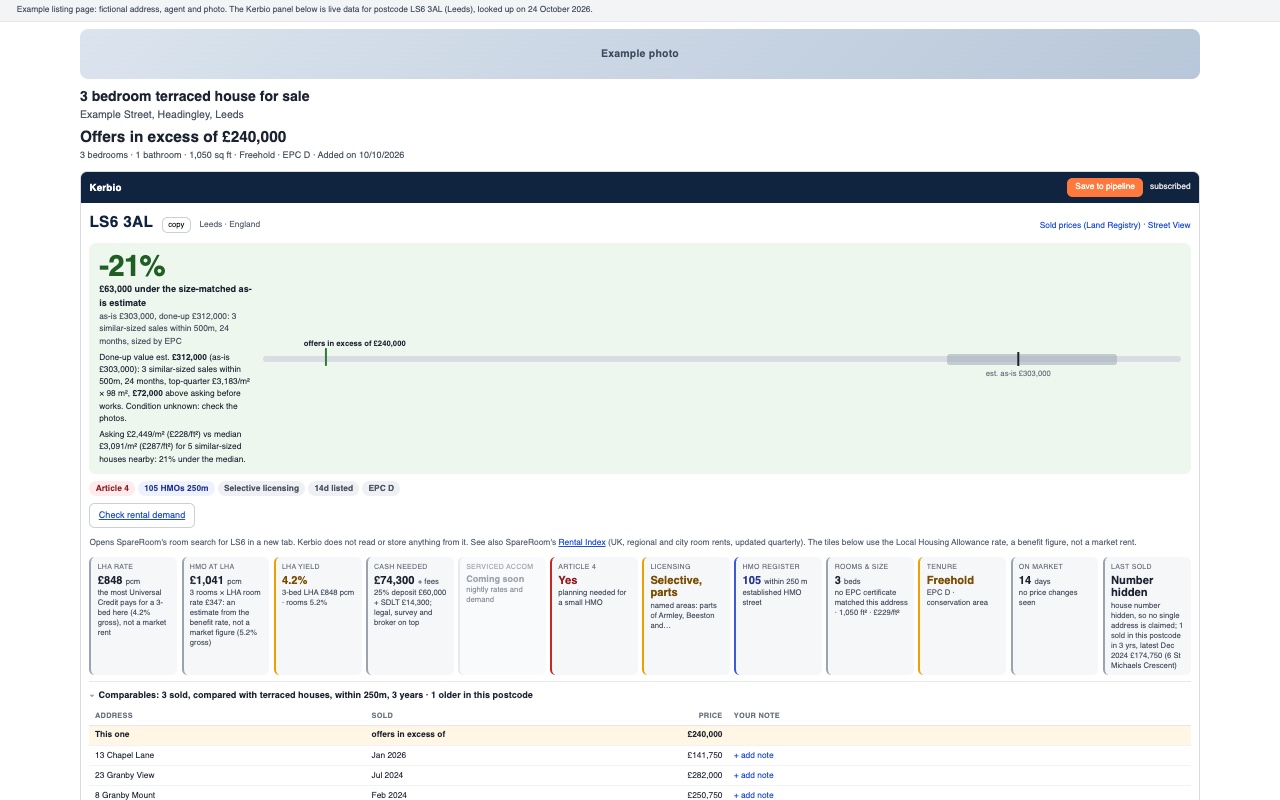
Sources
- Energy price cap to rise by 26% from January 2027 (Ofgem press release, 25 November 2026); Changes to energy price cap between 1 January and 31 March 2027 (Ofgem); cap levels by region (PDF)
- Changes to energy price cap between 1 October and 31 December 2026 (Ofgem)
- Household Energy Payment 2027: guidance for billing authorities (MHCLG, 24 November 2026); gov.uk announcement
Checked 25 November 2026. Quotations in SOURCES.txt. GB cap rates; the £100 payment is England only. General information, not financial, tax or legal advice.