 Kerbio
If the Bill passes, a ground rent above £250 a year on an existing lease falls to £250 from a commencement day the Government expects in 2028, and reaches a peppercorn 40 years after that day; new flats would be sold as commonhold, not leasehold; and a short lease would be cheaper to extend because marriage value goes. For a landlord who pays ground rent on a let flat that is a cost removed; for an investor who collects ground rents it is income capped and then ended; for anyone converting houses into flats it changes what can be sold. The Bill text is published (Bill 189) and the clause references are on this page; none of it is law.
Bill 189 of 2026-27 (bills.parliament.uk id 4331) had its First Reading in the House of Commons on 19 November 2026 and the text is published. Second Reading not scheduled. Proposed, not law.
First Reading: 19 November 2026 (First Reading, House of Commons) · Second Reading: not scheduled · Royal Assent: none. Bill page · Bill text · Guide to the Bill
What it means, by position
Ground rent capped at £250 then zero; the powers that can put the flat at risk over a small unpaid bill replaced by a court-led route; fee caps on permissions; a 990-year extension without marriage value once the Bill passes, which matters most under 80 years. Service charge rights from 1 April 2027 are already law.
costs cut, on the releaseIncome from ground rents above £250 a year would be reduced to £250 from the commencement day, expected in 2028, and all ground rent income on regulated pre-2022 leases would end 40 years after that. No compensation is in the Bill. A block could convert to commonhold with 50% of leaseholders in support.
income reduced, on the releaseCommonhold would be the standard for most new flats and homes, with narrow exceptions such as shared ownership, so selling leases and keeping a ground-rent freehold would not be the model for most new conversions. Expected around 2031, after the modernised commonhold arrives around 2029.
model changes, expected around 2031The ground rent cap, in the Bill's words
| Provision | What it says |
|---|---|
| Clause 160, Schedule 17 | Clause 160 and Schedule 17 amend the Leasehold Reform (Ground Rent) Act 2022. |
| New section 4A | New section 4A of the 2022 Act (Schedule 17, paragraph 6): for a regulated lease that is a pre-2022 Act lease, 'the permitted rent is (a) in respect of any time during the transitional period, an annual rent of £250; (b) in respect of any time after the transitional period, a peppercorn rent', and 'the transitional period means the period of 40 years beginning with the 2027 Act commencement day'. |
| Commencement day | The '2027 Act commencement day' is 'the day on which Schedule 17 to the Commonhold and Leasehold Reform Act 2027 came fully into force in relation to that lease' (new section 1(8)); rent reserved for any time before that day is untouched (new section 3(5)). Clause 205(4)(a): section 160 and Schedule 17 come into force 'on such day as the Secretary of State may by regulations appoint'; Part 1 (commonhold) and Part 2 (restrictions on new leasehold flats) likewise by regulations; the gigabit broadband sections two months after Royal Assent. |
| Which leases | A 'regulated lease' is a long lease of a single dwelling, granted for a premium, that is not an excepted lease (new section 1(2)); a 'pre-2022 Act lease' was granted before 30 June 2022 (1 April 2023 for a retirement home) or under a contract made before that day (new section 1(6) and (7)). Schedule 17, paragraph 3 removes the business-lease exception for pre-2022 Act leases and the exceptions for leases granted under the 1967 and 1993 Acts; new section 6A gives 1967 Act house extensions their own rule. |
| Rents below £250 | New section 7: a term reserving a prohibited rent 'has effect as if, in place of the prohibited rent, it reserved the maximum permitted rent', so a rent above £250 becomes £250 and a rent below it stays as the lease says. The Guide: "If leaseholders pay ground rent which is less than £250 but is due to rise over time, it can never be more than £250 a year. After 40 years almost all ground rents will change to a peppercorn (effectively zero)." |
| Shared ownership | New section 6B: for a shared ownership lease the cap applies to the rent on the tenant's share; the rent on the landlord's share is unaffected. |
| Enforcement | New sections 11A to 11C: a lead enforcement authority, the Secretary of State or a trading standards authority it appoints, to oversee and enforce the Act. The Guide: "Cap existing ground rents: measures in the Bill will cap ground rents in most existing residential leases at £250 a year, reducing to a peppercorn after 40 years. These measures will be enforced by trading standards. Leaseholders can also approach the tribunal if the landlord has wrongly charged a rent." |
Read from Bill 189 as introduced on 19 November 2026. The Guide's estimate: "This will provide immediate relief for the estimated 770,000 to 900,000 leaseholders that are currently paying over £250 per year." "The government is continuing to consider the treatment of so-called 'quid pro quo' leases where people agree to pay a higher ground rent in return for a lower premium."
What the Government says the Bill does
From the release of 19 November 2026: "Ground rent relief will be prioritised for leaseholders, with a new plan to bring the £250 annual cap into force six months after the Bill becomes law, expected in 2028. This cap on bills could benefit up to one million leaseholders." "New protections to be added to the Bill will also tackle the shock of huge repair bills, requiring building owners to check their condition, plan for works and build up funds ahead of time." "A revived commonhold model is expected to be up and running around 2029 and instead of everyone having to agree before a building can convert, just a 50% neighbour vote will be needed." "For future homeowners, commonhold will also become the norm for most new flats following a managed transition. This will give homeowners, lenders and developers time to prepare for the new system, as a ban on the sale of new leasehold is expected to take effect two and a half years after the modernised commonhold model comes into force, around 2031." And from the release of 18 November, measure by measure:
| Measure | The release's words |
|---|---|
| Ground rent | Capping ground rents at £250 a year in 2028: cuts bills for up to one million leaseholders and reduces ground rents to zero after 40 years. |
| Losing the home over small bills | Ending unfair threats to take away people's homes: removes outdated powers that can put a leaseholder's home at risk over relatively small unpaid bills, such as a disputed service charge and replaces them with a fairer, court-led system. |
| Permission and admin fees | Capping rip-off admin fees: gives ministers powers to cap excessive permission and administration fees, like asking permission to keep a pet or replace a front door. |
| New flats | Banning leasehold for new flats and homes: makes modernised commonhold the standard for most new flats (with narrow exceptions like shared ownership), meaning buyers own their home outright forever and run their building jointly from day one. |
| Converting a block | Easier route to switch to commonhold: drops the threshold for existing blocks to convert from 100% neighbour agreement down to 50% support, allowing non-consenting neighbours to remain on modified leases until they sell, so holdouts cannot block conversion for the rest of the building. |
| Freehold estates | Ending 'fleecehold' estate enforcement threats: protects people living on freehold housing estates from threats to take over their home over unpaid estate maintenance charges. The Bill will also protect up to 1.75 million freehold homes on so-called 'fleecehold' estates, removing unfair powers that allow management companies to take over families' homes because of unpaid fees. |
| Lease extensions | Unlocking cheaper, easier lease extensions and freehold purchases: fixes parts of the Leasehold and Freehold Reform Act 2024. This will help homeowners buy 990-year lease extensions, stop them having to pay their landlord's expensive costs in most cases and will scrap marriage value, an additional cost faced by leaseholders with 80 years or less remaining on their leases. Following passage of the Commonhold and Leasehold Bill: Cheaper and easier lease extensions and freehold purchases: including 990-year lease extensions and scrapping marriage value. The new Commonhold and Leasehold Reform Bill makes the legislative fixes needed before these reforms can be brought into force. |
| Broadband | Strengthening leaseholders' right to request a gigabit broadband connection: helps more leaseholders access fast and reliable broadband, which landlords can currently ignore. In future, landlords will have to respond within set timeframes. |
| Property agents | Separate legislative plans will also put in place an independent regulator of property agents, giving leaseholders, tenants and homebuyers a route towards better protections. |
The Commonhold and Leasehold Reform Bill applies to England and Wales. Property law is devolved in Scotland and Northern Ireland. The reforms are subject to passing through Parliament and achieving Royal Assent. Of the estimated 5.1 million leasehold homes across England and Wales, approximately 4.9 million are in England (2.72 million owner-occupied, 1.91 million privately rented, and 269,000 social rented) and 235,000 are in Wales. The existing forfeiture regime can ultimately put a leaseholder's home and equity at risk over unpaid sums as low as £350. Since commonhold was introduced in 2002, fewer than 20 commonhold developments containing fewer than 200 flats have been created.
Timeline: what is law and what is proposed
- 1 April 2027, lawService charge information rights and litigation cost rules (SI 2026/1128; SI 2026/1190). The service charge reforms.
- 1 November 2027, lawStandard service charge demand, annual report and accounts for private landlords; administration charge schedule; building insurance disclosure (SI 2026/1190, SI 2026/1181).
- Six months after Royal Assent, expected 2028Ground rent cap of £250 a year on most existing leases (Schedule 17, commenced by regulations under clause 205(4)(a)); a peppercorn 40 years after the commencement day.
- 1 November 2028, lawStandard demands, accounts and annual reports extended to social landlords.
- Around 2029, expectedThe modernised commonhold regime available for use, with conversion of an existing block at 50% support (Part 1, by regulations).
- Around 2031, expectedBan on the sale of new leasehold flats, about two and a half years after the commonhold regime starts (Part 2, by regulations).
- Second Reading, Royal Assent: no dates990-year extensions and the end of marriage value "as soon as possible after Royal Assent"; forfeiture abolished with statutory instruments to follow; broadband rights two months after Royal Assent.
The service charge dates of 1 April 2027, 1 November 2027 and 1 November 2028 are already law under the commencement order SI 2026/1128 and the two regulations made on 10 November 2026; they do not depend on this Bill.
Ground rent cap calculator
The ground rent cap calculator takes the ground rent a lease charges now, its review clause and the years left, and shows what the lease would charge against the proposed £250 cap year by year to 2068, with the cumulative difference. It illustrates the cap start as 1 January 2028 (the Bill leaves the day to regulations; the Government aims for six months after Royal Assent) and counts the 40 years from that day as new section 4A(3) does, both labelled on the page.
What is still unknown, as of 19 November 2026
- The exact day the cap starts: clause 205(4)(a) leaves it to regulations; the Government aims for six months after Royal Assent, expected in 2028, which depends on the Bill's passage.
- The Second Reading date and the rest of the timetable. Royal Assent has no date.
- What the 'few limited exceptions' to the cap are beyond those in Schedule 17 (excepted leases under section 2 of the 2022 Act), and how 'quid pro quo' leases will be treated: the Government says it is still considering them.
- The wording of the building condition, works planning and reserve fund duties the Government says it will add to the Bill: a commitment in the 19 November release, not yet in the text.
- When the commonhold regime and the ban on new leasehold flats start: both by regulations (clause 205(1) and (2)); the Government expects around 2029 and around 2031.
- Which 'narrow exceptions' keep leasehold for new flats, set out in Schedules 9 and 10, which this page has not summarised.
Questions
Is any of this law yet?
No. Bill 189 of 2026-27 (bills.parliament.uk id 4331) had its First Reading in the House of Commons on 19 November 2026 and the text is published. Second Reading not scheduled. Proposed, not law. The 19 November release: "All measures in the Bill are subject to parliamentary approval and Royal Assent. Timings for measures coming into force are therefore dependent on the Bill's progress through Parliament." Nothing on this page changes a lease today. The service charge dates of 1 April 2027, 1 November 2027 and 1 November 2028 are different: they are already law under SI 2026/1128 and do not depend on this Bill.
What happens to my ground rent?
New section 4A of the 2022 Act (Schedule 17, paragraph 6): for a regulated lease that is a pre-2022 Act lease, 'the permitted rent is (a) in respect of any time during the transitional period, an annual rent of £250; (b) in respect of any time after the transitional period, a peppercorn rent', and 'the transitional period means the period of 40 years beginning with the 2027 Act commencement day'. New section 7: a term reserving a prohibited rent 'has effect as if, in place of the prohibited rent, it reserved the maximum permitted rent', so a rent above £250 becomes £250 and a rent below it stays as the lease says. So a ground rent above £250 a year would fall to £250 from the day Schedule 17 is commenced, which the Government aims to make six months after Royal Assent and expects in 2028, and every regulated pre-2022 lease would move to a peppercorn 40 years after that day. The Guide: "If leaseholders pay ground rent which is less than £250 but is due to rise over time, it can never be more than £250 a year. After 40 years almost all ground rents will change to a peppercorn (effectively zero)." The ground rent cap calculator shows the difference year by year on stated assumptions.
I let a leasehold flat. What changes for me?
Four things in the release. The ground rent you pay would be capped at £250 and later fall to zero. The powers that can put a leasehold home at risk over small unpaid bills would be replaced by a court-led system. Ministers could cap permission and administration fees, the release's examples being a pet or a front door. And the fixes to the 2024 Act would let you buy a 990-year extension without marriage value, which matters most if the lease has 80 years or less left; the Guide says those will be commenced "as soon as possible after Royal Assent". Separately, from 1 April 2027 you can demand service charge information under rules already made: see the service charge reforms.
I own a freehold and collect ground rents. What changes?
Income from ground rents above £250 a year would be reduced to £250 from the commencement day, expected in 2028, and all ground rent income on regulated pre-2022 leases would end 40 years after that (new section 4A). The Bill has no compensation scheme; the exceptions are the 2022 Act's excepted leases, with shared ownership and 1967 Act leases given their own rules, and the Government says it is still considering 'quid pro quo' leases. If leaseholders in the block choose to convert to commonhold, 50% support would be enough. This page does not value a freehold or advise on selling one.
I convert houses into flats and sell the leases. What changes?
The release: "Banning leasehold for new flats and homes: makes modernised commonhold the standard for most new flats (with narrow exceptions like shared ownership), meaning buyers own their home outright forever and run their building jointly from day one." Commonhold would be the standard for most new flats and homes, so the model of selling leases and keeping the freehold with a ground rent would not be available for most new conversions. Part 2 of the Bill restricts the grant of long leases of flats in relevant buildings from a day set by regulations (clause 205(2)); the Government expects the modernised commonhold around 2029 and the ban about two and a half years later, around 2031.
What is commonhold?
A form of ownership in which each flat is owned outright, with no lease and no ground rent, and the owners run the building jointly through a commonhold association. It has existed in England and Wales since 2002 and has been little used. The release describes a "modernised" commonhold and an easier route for existing blocks to convert: 50% support instead of 100%, with non-consenting owners "on modified leases until they sell".
What about homes on private estates with estate charges?
"Ending 'fleecehold' estate enforcement threats: protects people living on freehold housing estates from threats to take over their home over unpaid estate maintenance charges." The release puts the number at up to 1.75 million freehold homes.
Is this legal or valuation advice?
No. It states what the Government's press release says the Bill will do, with the release's own words, and what is not yet known. For your lease, freehold or dispute, the Leasehold Advisory Service (LEASE) gives free advice to leaseholders in England and Wales.
About this guide
Written by Kerbio, a small independent UK tool for property investors, on 19 November 2026 from Bill 189 as introduced, the Guide to the Bill and the two MHCLG releases. Quotations are the sources' own words; clause references are to the Bill as introduced. An explainer, not legal, tax or valuation advice.
Kerbio is a Chrome extension that puts sold prices, Article 4, licensing and the council's HMO register on the listing you are reading.
See the extension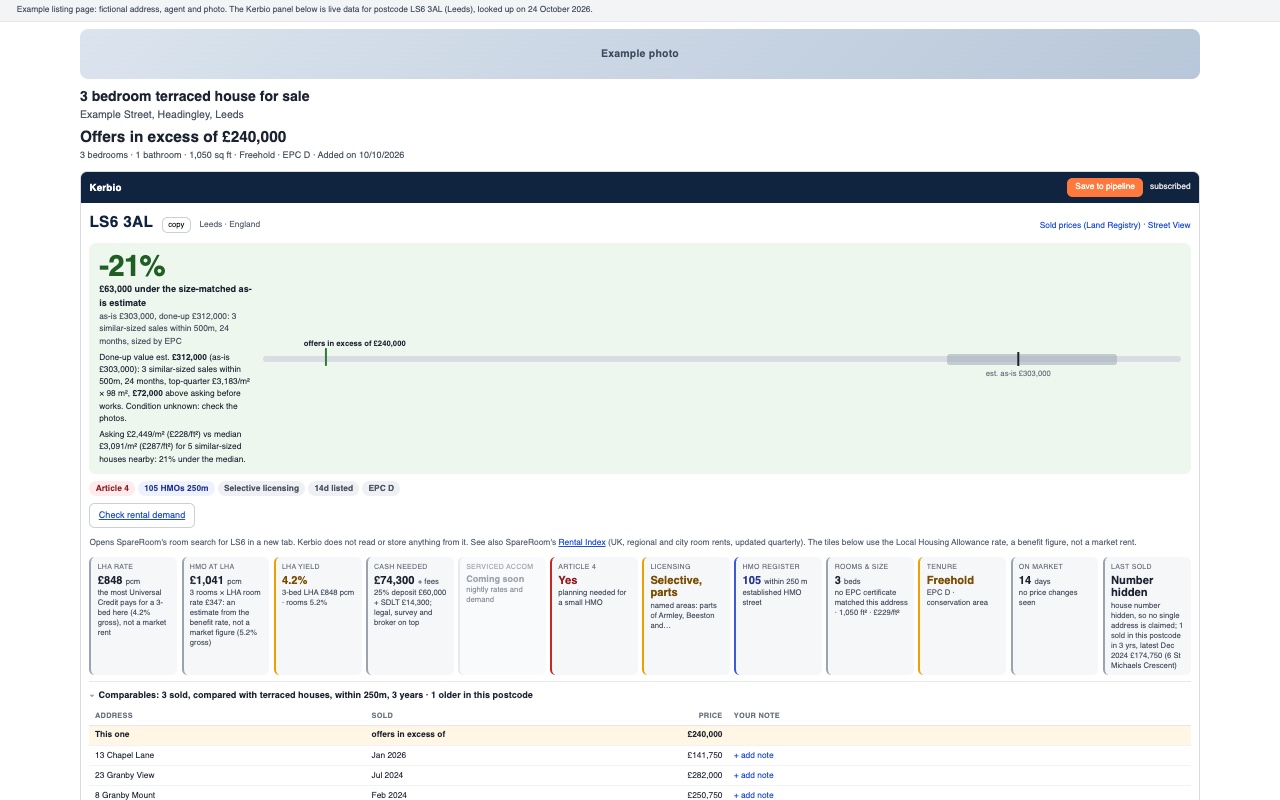
Sources
- Commonhold and Leasehold Reform Bill, Bill 189 of 2026-27, as introduced (clause 160, Schedule 17, clause 205); explanatory notes (PDF); Bill page with stages
- Guide to the Commonhold and Leasehold Reform Bill (MHCLG, 19 November 2026, 16:56); the Bill's document collection
- Historic move to dismantle leasehold and transform homeownership (MHCLG release, 19 November 2026, 14:28)
- Beginning of the end for thousand year old leasehold system (MHCLG release, 18 November 2026, 22:30)
- SI 2026/1128: Leasehold and Freehold Reform Act 2024 (Commencement No. 4 and Saving Provision) (England) Regulations 2026
- Leasehold and Freehold Reform Act 2024
- Leasehold Advisory Service (LEASE)
Checked 19 November 2026. Quotations in SOURCES.txt. England and Wales. General information, not legal, tax or valuation advice.