 Kerbio
If, on 14 February 2022, you owned four or more dwellings in the UK and the flat was not your main home, its lease is non-qualifying, and the Building Safety Act's caps on remediation service charges do not protect it. A qualifying lease pays nothing for cladding remediation and is capped for the rest. The government says it will lift the line from three dwellings to six through the Building Safety (Remediation of Unsafe Cladding etc) Bill, now in Committee; the amendment had not been tabled on 17 November 2026. The Bill itself puts a duty on whoever maintains the external walls to assess them within ten months and remediate, with penalties up to £500,000 that cannot be charged to leaseholders.
Building Safety (Remediation of Unsafe Cladding etc) Bill, Bill 155 (2026-27). Committee stage, House of Commons; sittings 12, 17, 19, 24 and 26 November 2026. Report stage: no date set when checked.
The three-to-six amendment the Secretary of State promised had not been tabled: 68 amendments were on the Committee papers by 17 November 2026, none from the Government and none on the leaseholder test. Notices of Amendments as at 16 November 2026 · Bill page
Qualifying leaseholder check
A reading of section 119 of the Building Safety Act 2022, with the proposed six-dwelling line shown separately. Nothing you enter leaves your browser.
On 14 February 2022
Result
The test also needs a long lease (over 21 years) of a single dwelling, a service charge, and a lease granted before 14 February 2022 (section 119(2)(a) to (c)). The status belongs to the lease: a later buyer inherits it. Buildings where the leaseholders have enfranchised or own the freehold, and commonhold, are outside the scheme (section 117(3)). A reading of the Act, not advice.
The three-dwelling rule, as the Act writes it
Section 119(2): A lease is a "qualifying lease" if (a) it is a long lease of a single dwelling in a relevant building, (b) the tenant under the lease is liable to pay a service charge, (c) the lease was granted before 14 February 2022, and (d) at the beginning of 14 February 2022 ("the qualifying time") (i) the dwelling was a relevant tenant's only or principal home, (ii) a relevant tenant did not own any other dwelling in the United Kingdom, or (iii) a relevant tenant owned no more than two dwellings in the United Kingdom apart from their interest under the lease.
"long lease" means a lease granted for a term of years certain exceeding 21 years; a person "owns" a dwelling in England, Wales or Northern Ireland if the person has a freehold interest in it or is a tenant under a long lease of it; "relevant tenant" means a person who, at the qualifying time, was the tenant, or any of the tenants, under the lease. A connected replacement lease (see section 119A) is also a "qualifying lease". The landlord must treat a lease meeting conditions (a) to (c) as qualifying unless it has taken all reasonable steps to get a certificate from the tenant and none is given (Schedule 8, paragraph 13).
Qualifying lease: what Schedule 8 stops
- Cladding remediation: nothing payable (paragraph 8).
- Other relevant defects: nothing payable if the landlord met the contribution condition (net worth above £2,000,000 per relevant building, paragraph 3) or the lease was worth under £325,000 in London or £175,000 elsewhere at the qualifying time (paragraph 4).
- Otherwise capped: £15,000 in Greater London, £10,000 elsewhere; £50,000 for a lease worth over £1,000,000; £100,000 over £2,000,000; no more than a tenth of the cap in any 12 months (paragraphs 5 to 7).
- Legal costs: nothing payable for legal or professional services about liability for a relevant defect (paragraph 9).
Non-qualifying lease: what still applies
- Paragraph 2, any lease in a relevant building: Paragraph 2 (any lease of premises in a relevant building, qualifying or not): no service charge is payable in respect of a relevant measure relating to a relevant defect if a relevant landlord is responsible for the relevant defect, or is associated with a person responsible for a relevant defect.
- Paragraph 11: other tenants cannot be charged more to make up for a protected lease.
- Nothing else in Schedule 8. The caps, the value exemption, the cladding bar and the legal costs bar are written for qualifying leases only.
- Remediation orders (section 123): anyone with a legal or equitable interest in the building can apply to the First-tier Tribunal for an order requiring the landlord to remedy defects by a date; this does not depend on the lease qualifying.
What the rule means for a landlord with four flats
Each lease is non-qualifying. Remediation service charges for the building's relevant defects, cladding included, can be demanded in full under the lease, subject only to paragraph 2 and the ordinary reasonableness rules in the Landlord and Tenant Act 1985.
no capA lease qualifies if it was your only or principal home on 14 February 2022, whatever else you owned; or if you owned no more than three dwellings in all. Each lease is tested on its own.
protectedThe test looks at the tenant on 14 February 2022, not today. A flat bought from a portfolio landlord after that date carries a non-qualifying lease; a flat bought from an owner-occupier carries a qualifying one. Ask for the leaseholder deed of certificate before exchange.
status travels with the leaseWhat the Bill does
Building Safety (Remediation of Unsafe Cladding etc) Bill (Bill 155 (2026-27)), introduced 14 October 2026, Second Reading 27 October 2026, Committee 12, 17 and 19 November 2026. Its long title: "Make provision about fire safety in buildings containing multiple dwellings, including provision for the assessment and remediation of external walls that give rise to risks from fire, and the mitigation of such risks, in taller buildings; to make provision for the obtaining and recording of information about buildings containing residential accommodation; to make provision about liabilities in connection with unsafe construction products; and to make other provision in connection with the safety and management of residential buildings."
| Clause | What it says |
|---|---|
| 1, 40 | Clause 1: the duties in Chapter 1 of Part 1 apply to relevant buildings completed before 28 June 2022. Clause 40: for Part 1, "relevant building" means a self-contained building, or self-contained part of a building, in England that contains at least two dwellings, and is at least 11 metres high or has at least five storeys. |
| 2, 42, 43 | Clause 2: the responsible entity must ensure a compliant fire risk assessment of the external walls is carried out by a suitable professional, by the end of ten months beginning with the day the section comes into force (the "assessment deadline"). Clause 42: a person is a "responsible entity" in relation to the external walls of a relevant building if the person is required, under a lease or by virtue of an enactment, to repair or maintain those walls. Where there are two or more, they are liable jointly and severally. Clause 43: "external wall" includes doors or windows in an external wall, any cladding product, balcony or other thing attached to the exterior, and anything located within any space forming part of an external wall. |
| 7, 8, 14 | Clause 8: a duty to remediate where an assessment recommends remediation works; clause 7 a duty to implement interim measures as soon as reasonably practicable. Clause 14: a responsible entity under the duty to remediate must prepare and disseminate a remediation compliance plan, give a copy to each tenant under a lease of a dwelling in the building, and display a notice in the building. |
| 6, 12, 13 | Clause 6: a financial penalty not exceeding £14,000 for failing the assessment duty (an offence under clause 5), plus not exceeding £500 for each day the failure continues. Clauses 12 and 13: failing the duty to mitigate or remediate is an offence; as an alternative to prosecution a relevant enforcement authority may impose a financial penalty not exceeding £500,000, and more than one penalty for different periods. |
| 34, Sch 1 | Clause 34 and Schedule 1: remediation management orders, under which the tribunal can give a local housing authority or Homes England power to remediate a building where the responsible entity has failed. Schedule 1, paragraph 23: inserts a new paragraph 8A into Schedule 8 of the 2022 Act, so that no service charge is payable under a qualifying lease for a remediation authority's ancillary expenses or administration charge under a remediation management order, unless the tribunal orders otherwise on the landlord's application. |
| 48, 64 | Clause 48: Part 2 creates a register of "medium-rise buildings": at least 11 metres or five storeys, less than 18 metres and fewer than seven storeys, with at least two residential units. Clause 64: a new section 30IZA of the Landlord and Tenant Act 1985 lets the cost of registering a medium-rise building and providing information to the registrar be charged through a variable service charge under leases of seven years or more, apportioned as insurance costs are. |
| 91 | Clause 91: regulations under section 123 of the 2022 Act may let the tribunal impose a financial penalty for failing to comply with a remediation order, up to £500,000, with successive penalties for a continued failure; and up to £40,000 for failing an information requirement (figures from the Bill's new section 123(2D) and the Explanatory Notes, paragraphs 40 and 41). |
| 105 | Clause 105: a new section 20FZA of the Landlord and Tenant Act 1985. Costs a landlord incurs solely as a result of a penalty or other enforcement action under the remediation legislation, or by reason of its own contravention, are "excluded costs" and are not relevant costs for a variable service charge. The exclusion does not apply where the landlord is a leaseholder-controlled company and the tenant is a member of it. |
| 115 | Clause 115: Part 7 and the regulation-making powers commence on Royal Assent; Parts 1, 3, 4 and 5 and most of Part 6 commence two months after Royal Assent; Part 2 (the register) and the rest on days appointed by regulations. |
Read from the Bill as introduced on 17 November 2026. Nothing in the Bill as introduced changes section 119 of the 2022 Act: the qualifying lease test, including the three-dwelling limit, is unchanged in the Bill text.
What is proposed but not in the Bill
Angela Rayner, Secretary of State for Housing, Communities and Local Government, at Second Reading, HC Deb 27 October 2026, vol 792, col 220: "We have also heard those who have spoken about the plight of those with small portfolios who were excluded from protection. As the Bill passes through Parliament, I will table amendments to expand the protection from three to six properties."
"We have also heard from those who bought their first home, only to find it was a non-qualifying lease. The Government will investigate whether we can extend the protection to any leaseholder who owns a lease on their only or principal home."
Asked by Hilary Benn (col 221) whether someone who has already bought a non-qualifying flat would benefit, the Secretary of State said: "We are hoping to make sure that nobody is left out, or left feeling those pressures" and that the Building Safety Minister would meet Members "to see how far we can go". No commitment on retrospection was given.
The three-to-six amendment the Secretary of State promised had not been tabled: 68 amendments were on the Committee papers by 17 November 2026, none from the Government and none on the leaseholder test.
Timeline
- 14 February 2022The qualifying time: the day the Act tests ownership and residence (section 119).
- 28 June 2022Sections 117, 119, 123 and Schedule 8 of the Building Safety Act 2022 in force.
- 14 October 2026Bill introduced in the Commons (First Reading).
- 27 October 2026Second Reading; the three-to-six commitment, Hansard col 220.
- 12, 17, 19, 24 and 26 November 2026Public Bill Committee. The three-to-six amendment the Secretary of State promised had not been tabled: 68 amendments were on the Committee papers by 17 November 2026, none from the Government and none on the leaseholder test.
- Report stage, Lords, Royal AssentNo dates. Part 1 duties start two months after Royal Assent (clause 115); the assessment deadline is ten months after that (clause 2).
Before buying a flat from a landlord
Ask for the leaseholder deed of certificate and the landlord's certificate for the lease. The certificate records the position at 14 February 2022; a lease with none is treated as qualifying only until the landlord has taken all reasonable steps to get one (Schedule 8, paragraph 13).
Ask whether the building is a relevant building (11 metres or five storeys, two or more dwellings) and whether the leaseholders have enfranchised or own the freehold, which takes the building outside Schedule 8 (section 117(3)) and makes the leaseholders' company the responsible entity under the Bill.
Ask for the external wall assessment and any remediation compliance plan; under the Bill a copy of the plan must go to every tenant under a lease of a dwelling (clause 14).
Check the building's status in MHCLG's remediation data: 4,732 buildings of 11 metres or more were identified with unsafe cladding at the end of September 2026, 1,878 of them remediated.
Do not rely on the six-dwelling change until an amendment is tabled and passed; price the flat on current law.
Where to find a building's remediation status
As at the end of September 2026, there are 4,732 residential buildings 11 metres and over in height identified with unsafe cladding whose remediation progression is being reported on in this release. Of the 4,732 11m+ buildings identified with unsafe cladding, 2,621 (55% of monitored buildings) have started or completed remediation works, of which 1,878 (40% of monitored buildings) have completed remediation works. MHCLG's best estimates, as of March 2026, are that there are between 5,900 and 7,400 residential buildings, containing dwellings, 11 metres and over in height that have or had unsafe cladding requiring work in England. As of March 2025, MHCLG estimates that it will cost between £11.8bn and £22.7bn to remediate residential buildings, containing dwellings, 11 metres and above in height that have or had unsafe cladding in England. The release does not say how many of the flats in those buildings are owned by landlords, or how many leases are non-qualifying; no such figure appears on this page. The release, with its management information tables, is at gov.uk; the Bill's Part 2 register of medium-rise buildings (clause 48) does not exist yet.
Not stated, as of 17 November 2026
- The three-to-six amendment itself. It had not been tabled when checked; its wording, whether it would be retrospective for people who bought a non-qualifying lease, and whether it would change the 14 February 2022 test are unknown.
- Any extension to every only-or-principal-home leaseholder: the Secretary of State said the government "will investigate", nothing more.
- When the duties start: the Bill is at Committee stage; Report stage and the Lords have no dates. Clause 115 sets Part 1 to start two months after Royal Assent, and the assessment deadline runs ten months from that.
- How many landlord-owned flats sit in affected buildings: not in the MHCLG release.
- Whether the Bill helps a non-qualifying leaseholder with a remediation bill already demanded: it does not change Schedule 8's qualifying tests, so no.
Questions
I own four leasehold flats. Am I protected from cladding costs?
Not by the qualifying lease rules, unless one of the flats was your only or principal home on 14 February 2022: section 119(2)(d) of the Building Safety Act 2022 protects a lease where, at the beginning of that day, the tenant owned no more than two other dwellings in the UK, so three in all. With four, each lease is non-qualifying, and paragraphs 3 to 9 of Schedule 8 (the caps, the low-value exemption, the cladding remediation bar and the legal costs bar) do not apply to it. Paragraph 2 still applies to every lease in a relevant building: no service charge for a defect the landlord, or a person associated with it, is responsible for. The government has said it will table amendments to move the limit from three to six; that had not been tabled when this page was checked on 17 November 2026.
Does the Bill change the three-dwelling test?
Not as introduced. Nothing in the Bill as introduced changes section 119 of the 2022 Act: the qualifying lease test, including the three-dwelling limit, is unchanged in the Bill text. The change was announced by the Secretary of State at Second Reading on 27 October 2026 as something she would table during the Bill's passage (HC Deb 27 October 2026, vol 792, col 220). This page will say so when an amendment appears.
If I buy a flat from a landlord who was non-qualifying, do I inherit that?
Yes. Section 119 applies the test to the lease, by reference to the tenant at the beginning of 14 February 2022 (the "relevant tenant"); the result attaches to the lease and does not change on sale. A buyer of a non-qualifying lease takes it as non-qualifying, and a buyer of a qualifying lease keeps the protection. Hilary Benn asked at Second Reading whether a later buyer would benefit from the promised change; the Secretary of State said the government hopes "to make sure that nobody is left out" and gave no commitment (col 221).
What does the Bill make the building owner do?
Clause 2: the responsible entity must ensure a compliant fire risk assessment of the external walls is carried out by a suitable professional, by the end of ten months beginning with the day the section comes into force (the "assessment deadline"). Clause 8: a duty to remediate where an assessment recommends remediation works; clause 7 a duty to implement interim measures as soon as reasonably practicable. Clause 14: a responsible entity under the duty to remediate must prepare and disseminate a remediation compliance plan, give a copy to each tenant under a lease of a dwelling in the building, and display a notice in the building. The responsible entity is whoever must repair or maintain the external walls under the lease or by law (clause 42), which for most blocks is the freeholder or head lessee, and for an enfranchised block the leaseholders' company.
What are the penalties?
Clause 6: a financial penalty not exceeding £14,000 for failing the assessment duty (an offence under clause 5), plus not exceeding £500 for each day the failure continues. Clauses 12 and 13: failing the duty to mitigate or remediate is an offence; as an alternative to prosecution a relevant enforcement authority may impose a financial penalty not exceeding £500,000, and more than one penalty for different periods. Clause 91: regulations under section 123 of the 2022 Act may let the tribunal impose a financial penalty for failing to comply with a remediation order, up to £500,000, with successive penalties for a continued failure; and up to £40,000 for failing an information requirement (figures from the Bill's new section 123(2D) and the Explanatory Notes, paragraphs 40 and 41). Penalty costs cannot be put through the service charge: Clause 105: a new section 20FZA of the Landlord and Tenant Act 1985. Costs a landlord incurs solely as a result of a penalty or other enforcement action under the remediation legislation, or by reason of its own contravention, are "excluded costs" and are not relevant costs for a variable service charge. The exclusion does not apply where the landlord is a leaseholder-controlled company and the tenant is a member of it.
Which buildings?
Clause 40: for Part 1, "relevant building" means a self-contained building, or self-contained part of a building, in England that contains at least two dwellings, and is at least 11 metres high or has at least five storeys. Chapter 1 duties apply to such buildings completed before 28 June 2022 (clause 1). The same height test defines a "relevant building" for the leaseholder protections in the 2022 Act (section 117), which also excludes enfranchised, leaseholder-owned and commonhold buildings.
When does any of this start?
Clause 115: Part 7 and the regulation-making powers commence on Royal Assent; Parts 1, 3, 4 and 5 and most of Part 6 commence two months after Royal Assent; Part 2 (the register) and the rest on days appointed by regulations. When the duties start: the Bill is at Committee stage; Report stage and the Lords have no dates. Clause 115 sets Part 1 to start two months after Royal Assent, and the assessment deadline runs ten months from that.
Is this legal advice?
No. It states what the Act and the Bill say, with the wording quoted, and what the Secretary of State said in Hansard. Whether your lease qualifies depends on facts about 14 February 2022 and on your lease; the Leasehold Advisory Service (LEASE) gives free advice to leaseholders in England and Wales.
About this guide
Written by Kerbio, a small independent UK tool for property investors, on 17 November 2026 from the Building Safety Act 2022 and the Bill on Parliament's own sites, Hansard and MHCLG's remediation statistics. Quotations are the sources' own words. An explainer, not legal advice.
Kerbio is a Chrome extension that puts sold prices, Article 4, licensing and the council's HMO register on the listing you are reading.
See the extension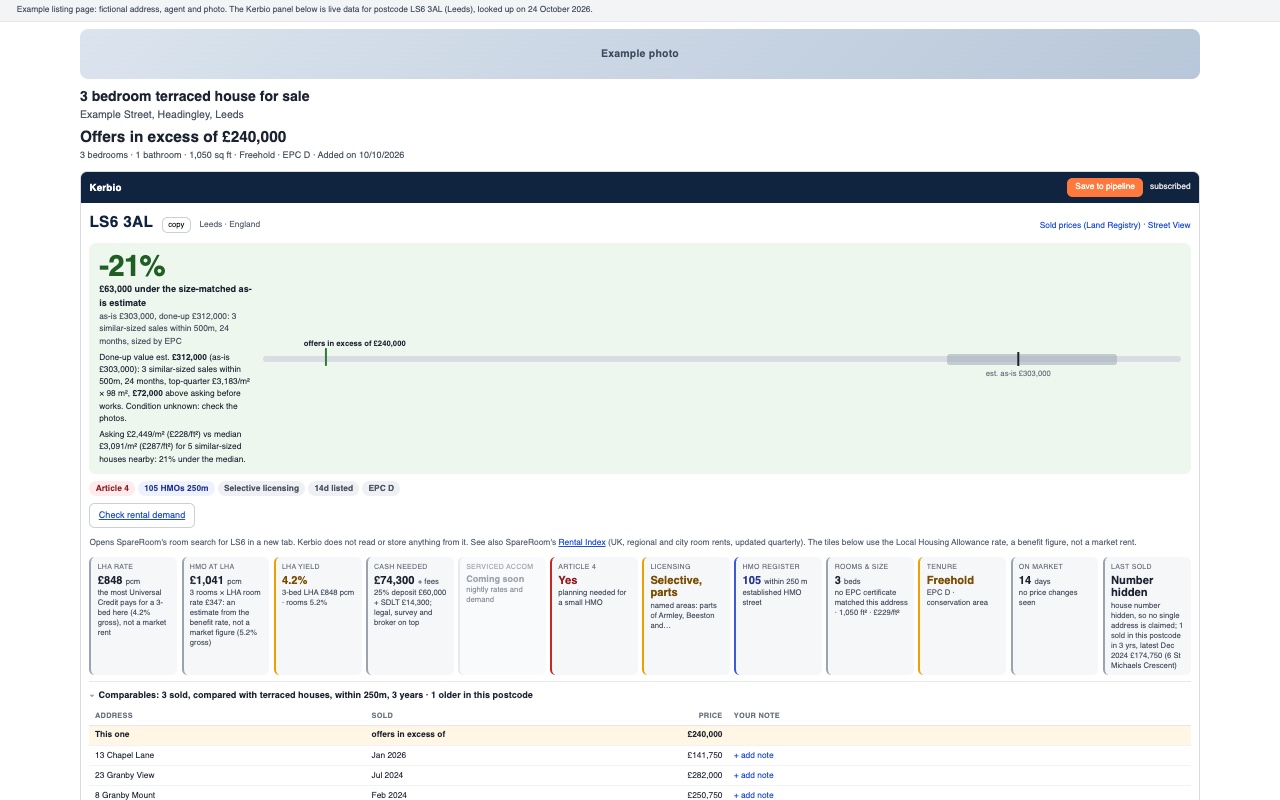
Sources
- Building Safety Act 2022, section 119 (qualifying lease); section 117 (relevant building); section 123 (remediation orders); Schedule 8 (legislation.gov.uk)
- Building Safety (Remediation of Unsafe Cladding etc) Bill, Bill 155 (2026-27), as introduced; Explanatory Notes (PDF); Bill page with stages; Commons Library briefing CBP-12249
- Hansard, Second Reading, 27 October 2026 (vol 792, cols 214 onwards)
- Notices of Amendments as at 16 November 2026 (amendment paper, PDF)
- Building Safety Remediation: monthly data release, September 2026 (MHCLG, published 28 October 2026)
- Leasehold Advisory Service (LEASE)
Checked 17 November 2026. Quotations in SOURCES.txt. England only. General information, not legal advice.