 Kerbio
The Bank of England raised Bank Rate by 0.25 percentage points to 4% on 5 November 2026. The vote was 8 to 1 (one member preferred a rise of 0.5 percentage points, to 4.25%). On a tracker or variable-rate mortgage, 0.25 points is about £21 a month for every £100,000 once the lender applies it; a fixed-rate mortgage does not change until the fix ends; on a bridge it is 0.021% a month if the lender passes it on.
The decision, in the Bank's words
| Item | 5 November 2026 | 17 September 2026 |
|---|---|---|
| Bank Rate | 4% | 3.75% |
| Vote | 8 to 1 | 6 to 3 |
| Minority view | one member preferred a rise of 0.5 percentage points, to 4.25% | three members preferred a rise of 0.25 percentage points, to 4% |
| MPR projection, CPI inflation at the end of 2027 | 4.0% (central projection, 2027 Q4) | |
| Market path for Bank Rate the projection assumes | the market curve rises to around 4.9% at the end of 2027 before gradually falling to around 4.7% by late 2029 (15-day average to 27 October) | |
| Next decision | 17 December 2026 |
CPI inflation was 3.5% in September, and the Bank's central projection has it at around 5% by the middle of 2027.
What it means for a landlord
A tracker moves by the stated margin from the date your lender applies the change: 0.25 points on the annual rate, about £21 a month for every £100,000 on interest-only. A lender's own variable rate moves when the lender decides.
Check your product termsNothing changes until the fix ends. What you pay next depends on the products on offer then, which lenders price off swap rates, not Bank Rate directly.
No change todayLenders set their own stress rates, usually the higher of a floor and a margin over the product rate. Today's decision does not change a stress test by itself; a lender's next repricing might. Put the quoted figure into our calculator.
Lender by lenderMonthly rates often sit over Bank Rate or SONIA. 0.25 points a year is 0.021% a month: about £31 a month on £150,000. Interest fixed at drawdown does not change.
Calculator belowWhat a 0.25 point move costs on your loan
Arithmetic, not a quote: loan size times the change in the annual rate, divided by twelve, times the months. Lenders decide whether and when to pass a Bank Rate move on.
Your loan
Only interest changes; fees and exit costs do not.
Extra interest if your rate moves by the same amount
What this page does not say
- The decision and the vote, from the Bank's own summary.
- The Bank's own sentence on the outlook, quoted.
- The arithmetic of the move on a mortgage or a bridge.
- The next decision date.
- No forecast of the next decision.
- No claim about where mortgage rates go next: lender pricing follows swaps and funding, not Bank Rate alone.
- No tax, legal or financial advice.
Questions
What did the Bank of England decide?
The Bank of England raised Bank Rate by 0.25 percentage points to 4% on 5 November 2026. The Monetary Policy Committee voted 8 to 1; one member preferred a rise of 0.5 percentage points, to 4.25%. Bank Rate had been 3.75% since 17 September 2026, when the vote was 6 to 3 (three members preferred a rise of 0.25 percentage points, to 4%).
Does this change my buy-to-let mortgage payment?
Only if your rate follows Bank Rate. On a tracker the rate moves by 0.25 points from the date your lender applies the change: on interest-only borrowing that is about £21 a month for every £100,000 (loan times 0.25%, divided by 12). A lender's own variable rate moves only if the lender changes it. On a fixed rate nothing changes until the fix ends. Check your product terms rather than assuming.
I am on a fixed rate. What changes?
Nothing until the fix ends. What you pay after that depends on the products on offer then. Lenders price fixed rates off swap rates and their own funding, not Bank Rate directly, and they reprice when they choose. This page does not forecast those prices.
What about the lender's stress test?
Lenders set their own stress rates for the rent test, usually the higher of a floor and a margin over the product rate. Our free buy-to-let calculator uses 5.5% as an editable default; put in the figure your lender quotes. A Bank Rate decision does not change a stress test by itself.
What does it mean for bridging?
Most bridging is priced as a monthly rate, often quoted as a margin over Bank Rate or SONIA. Arithmetic only: a 0.25 point move in the annual rate is about 0.021% a month (0.25 divided by 12). On a £150,000 bridge over 9 months that is about £281. Whether and when a lender passes it on is their decision.
Is this advice?
No. It is the decision, the vote and the Bank's own words, with the arithmetic of a rate move. It does not predict the next decision and it does not say what mortgage rates will do. Speak to a broker about your own position.
When is the next decision?
17 December 2026 (no Monetary Policy Report that month); then 4 February 2027.
About this page
Written by Kerbio, a small independent UK tool for property investors, from the Bank of England's own decision page, minutes and Monetary Policy Report on 5 November 2026. Nobody paid for it. The free buy-to-let and bridging calculators take whatever rate your lender quotes.
Kerbio is a Chrome extension that puts sold prices, Article 4, licensing, the council's HMO register and LHA rates on the property listing you are reading.
See the extension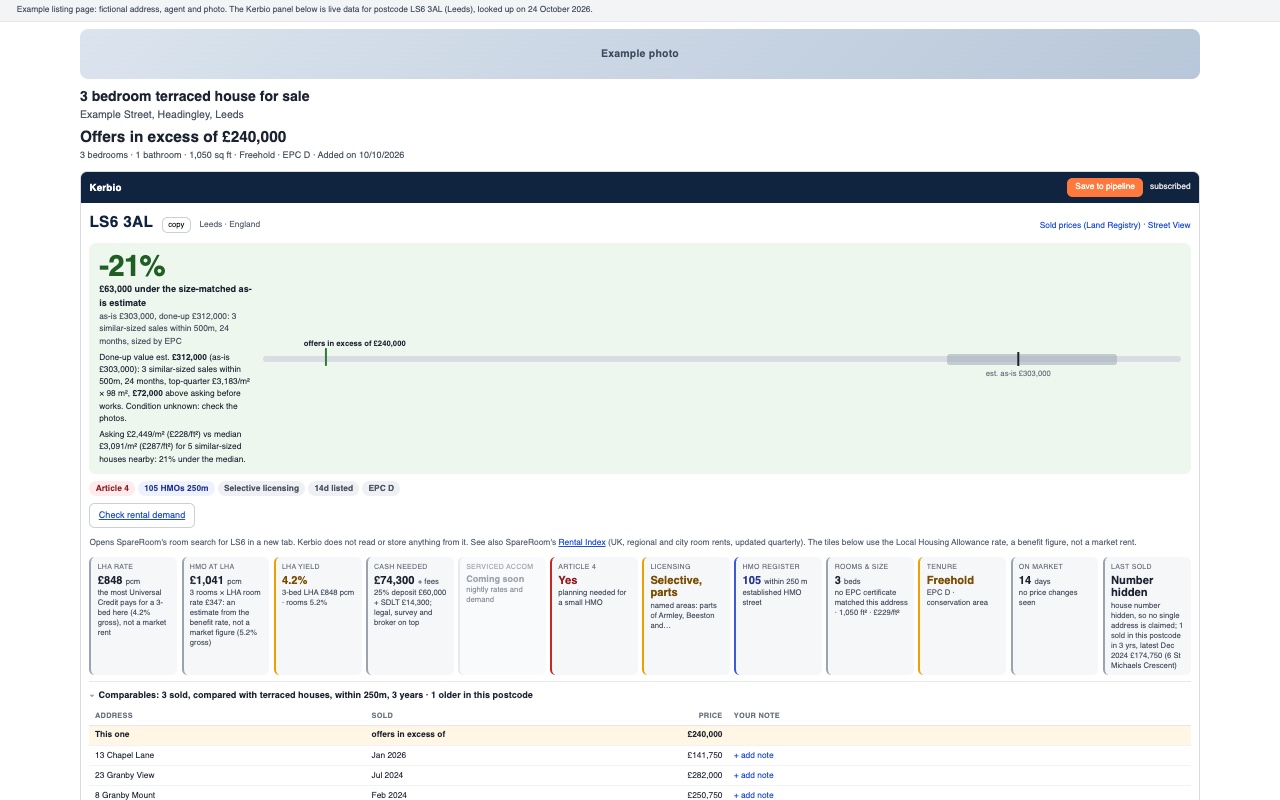
Sources
- Monetary Policy Summary and minutes, 5 November 2026 (Bank of England)
- Bank Rate (Bank of England)
- Monetary Policy Report, November 2026 (Bank of England)
- Monetary Policy Summary and minutes, 17 September 2026 (Bank of England)
- Upcoming MPC dates (Bank of England)
Checked 5 November 2026, 12:00. General information, not financial advice.